
AI data centers bought out nearline hard drive supply. Western Digital says it is sold out through calendar 2026, Seagate calls its nearline capacity fully allocated, and ComputerBase measured German retail HDD prices up 129 percent since September 2025. Across TechFuelHQ’s three 2026-08-25 captures, qualifying new 8TB drives ran $41 to $61 per terabyte.
By LK Wood IV · 2026-08-26 · ~12 min read · St. Louis County, MO
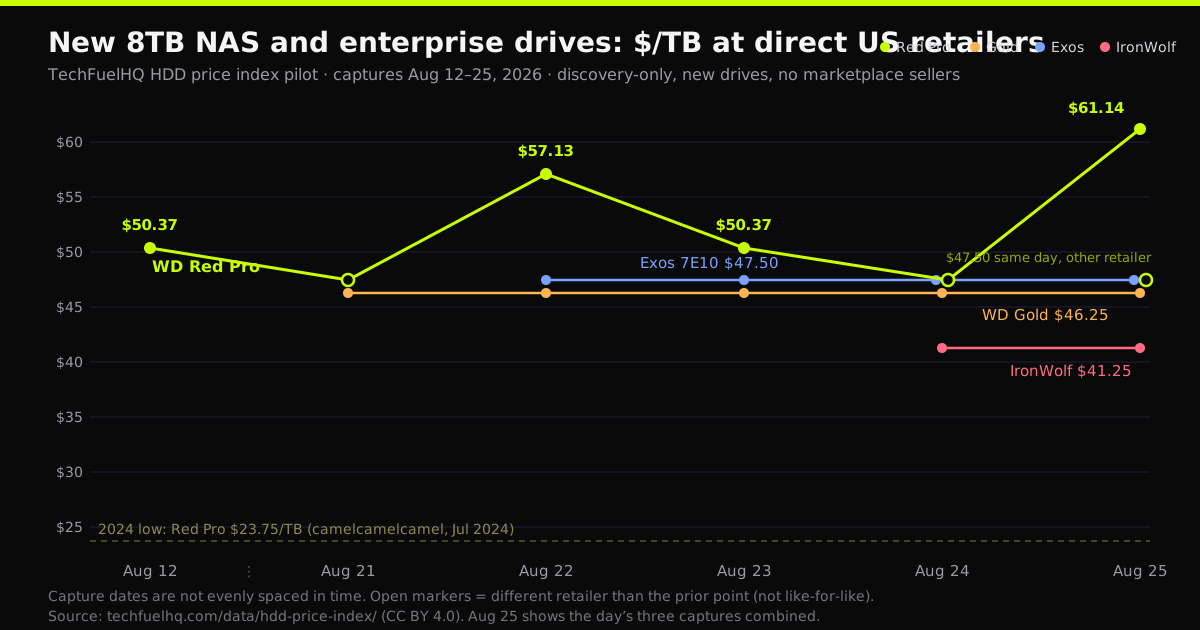
$489.11. That is what Best Buy asked for a WD Red Pro 8TB on August 25, 2026 — the same listing, same retailer, that had listed at $402.99 two days earlier. A 21 percent jump in 48 hours, on a drive Western Digital’s own store sold for $189.99 on sale on July 17, 2024.
Multiply that shock across every NAS builder, backup hoarder, and Plex admin refreshing a cart this year and you get the anger filling an r/homelab thread titled “Hard drive prices have doubled over one year. WTF is going on” (340+ comments when I checked it on August 25), plus fresh siblings in r/selfhosted and r/DataHoarder. The threads argue from screenshots. This page argues from a dated, downloadable price series I run myself, plus the primary statements from the two biggest makers of the drives you can buy.
TL;DR · The 2026 hard drive squeeze
- What happened: retail HDD prices rose 20-50% by early 2026 and kept going. ComputerBase's tracker had them up 129% vs September 2025 by mid-August. Our own three same-day captures put new 8TB drives at $41-61 per TB, 1.7-2.6x the $23.75 per TB Western Digital's store charged for the same Red Pro SKU in July 2024.
- Why: AI data centers bought the supply. WD says it is sold out through calendar 2026; Seagate calls nearline capacity fully allocated. Neither is expanding production.
- When it ends: nothing citable points to consumer relief before 2027, and contracts already run into 2027-2028.
- What to do: buy what the build needs and skip the stockpile. If a build is blocked on a drive, buy the low end of the measured range now; if you can wait a year, wait. The per-case calls are below.
What an 8TB NAS drive costs right now, measured
I run a price capture against Google Shopping for twelve named 8TB drive lines — NAS, surveillance, enterprise, desktop — and publish every qualifying observation with its date in the HDD price index. The rules are strict on purpose. A listing only counts if it comes from a named direct US retailer (no marketplace storefronts), states the exact line and the 8TB capacity in its title, is a single new internal drive (no multi-packs, no external enclosures), and is not recertified or white-label. Most listings fail. On day one, 672 of 673 did.
Here is what qualified in the day’s final capture on August 25, 2026 — the one published in the index’s downloadable CSV:
| Drive | Price | $/TB | Retailer |
|---|---|---|---|
| Seagate IronWolf 8TB | $329.99 | $41.25 | Best Buy, Newegg |
| WD Gold 8TB | $369.99 | $46.25 | Central Computers |
| Seagate Exos 7E10 8TB | $379.99 | $47.50 | Adorama |
| WD Red Pro 8TB | $379.99 | $47.50 | Newegg |
Four lines out of twelve. Every row carries verification_status: discovery_only; I have not phoned a warehouse to confirm stock. One open flag carried from the index: the Exos 7E10 row’s listing title reads SAS while the tracked part is the SATA variant, ST8000NM017B. Unresolved. That row stays discovery-only until a retailer page settles it.
Two things in that table deserve their own paragraphs.
The WD Red Pro swing is real and I can show the receipts. One Best Buy listing, same product cluster and same seller across captures: $457.04 on August 22, down to $402.99 on August 23, up to $489.11 on August 25 (on August 24 the same cluster surfaced under Newegg instead, a seller flip the index does not treat as comparable). That is a 21 percent range inside four days on a single SKU at a single retailer. Anyone quoting you “the” price of a drive this month from one screenshot is off by up to a fifth before they finish typing.
Single snapshots lie even harder within a day. I ran three captures on August 25. The first saw the Red Pro at Best Buy for $489.11 and no first-party IronWolf anywhere; the third, twelve minutes later, saw the IronWolf at two direct retailers and the Red Pro at Newegg for $379.99, which is $109 under the Best Buy ask on the same Google product listing. Same afternoon, same method, different slices of Google Shopping’s inventory. This churn is exactly why the index refuses to publish a headline median until six of the twelve tracked lines qualify on the same day — a gate that has stayed closed since the pilot began on August 12 — and why the unit of evidence here is a dated series, not a screenshot.
The marketplace premium showed up the same day. Across the day’s captures, marketplace storefronts on Newegg asked $469.99 and $513.99 for the same IronWolf 8TB that Newegg itself and Best Buy listed at $329.99 — 42 to 56 percent over the direct price. The index rejects those rows. Your cart should too.
Step 1: what kind of buyer are you?
There is no one answer to “should I buy a hard drive right now.” There is an answer per situation, and the way to order them is by what a wrong call costs you, so that is the order used here.
Building a NAS you need this year. Buy, and buy the boring low end of the measured range. In the day’s captures that means the cheapest qualifying line, IronWolf 8TB at $41.25/TB, over the premium lines that ran $46-61. The NAS drive buying guide carries the actual picks and the CMR-vs-SMR rules. Waiting costs you a year of not having the machine, and nothing citable says next spring is cheaper.
Expanding an existing pool. Size the real need first with the NAS storage calculator. RAID and filesystem overhead mean the terabytes you must buy are not the terabytes you get. Then buy only the expansion and skip the “while I’m at it” spare. At $41-61/TB, speculative spares are the most expensive comfort object in the hobby.
Backup-only. You need capacity once, not performance, and this is where used and recertified enterprise drives earn their keep if you accept the trade; more on that two sections down. A backup target with redundancy plus an offsite copy tolerates a cheaper drive.
Media hoarding at scale. You feel this market hardest, because $/TB is your whole cost model and on the Red Pro 8TB it doubled, from $189.99 at Western Digital’s own store in July 2024 to $379.99 listings now. Shop by $/TB across 8-16TB rather than assuming bigger is cheaper. Our July pull found the 12TB Red Plus pricier per TB than the 8TB. Recertified big-capacity CMR is the standing value play, eyes open.
No urgent need. Do nothing. Prices this distorted make “upgrade because it’s Tuesday” a luxury purchase. Check the index monthly; it exists so you can see a real trend instead of guessing from forum sentiment.
Why are hard drives so expensive in 2026?
Because the people who make them sold out. Literally, and they said so in public.
On Western Digital’s second-quarter earnings call, as reported by heise in February 2026, CEO Irving Tan told analysts the company is “pretty much sold out for calendar year 2026,” with “firm purchase orders with our top seven customers through calendar year 2026” and, per the same report, long-term agreements with three major customers extending through 2027 and 2028. Seagate’s CEO Dave Mosley said the same thing in his own words: nearline capacity “fully allocated through calendar year 2026,” with order-taking for the first half of 2027 expected “in the coming months.” Per heise’s report, nearline — the high-capacity 3.5-inch class that cloud and AI buyers take — is 87 percent of Seagate’s hard drive sales, and the company is not expanding production capacity to chase the spike.
Sit with that combination for a second. The two biggest hard drive makers have pre-sold their output to a handful of hyperscale customers, years forward, at contract prices. Nobody cut a factory’s output this time. The factories are running; their output just has someone else’s name on it.
Retail gets the remainder, and the remainder got expensive fast. Tom’s Hardware measured an average 46 percent rise across popular high-capacity drives between September 2025 and mid-January 2026, with the 24TB BarraCuda crossing $500. heise put the broader retail rise at 20-50 percent by mid-February. By ComputerBase’s August 15, 2026 storage-price check — a German price-comparison basket that deliberately excludes eBay and marketplace scalpers — hard drives stood 129 percent above September 2025, a new record for the series and still climbing month over month. German retail is not US retail, but it is the cleanest continuously-published basket anyone maintains, and our own US spot observations sit at 1.7x to 2.6x the tracked 2024 low, depending on the line.
Why did it hit hard drives later than RAM?
The RAM and SSD half of this story broke first and broke harder: memory makers reallocated wafer capacity toward AI data-center memory, and consumer DDR5 and NVMe prices roughly tripled through 2025 into 2026. That page carries the mechanism and the numbers; the two-sentence version is that your DIMM lost a bidding war to a server.
Hard drives lagged for a structural reason. DRAM and NAND trade close to spot: when wafers moved, consumer prices moved within weeks. Nearline hard drives sell overwhelmingly on long-term contracts, so the AI demand surge spent 2025 quietly consuming contract capacity before retail felt anything. ComputerBase’s single instrument shows the sequencing plainly: by August 2026 its RAM basket was up 345 percent from September 2025 while hard drives were up 129. The same shock, arriving through a slower pipe. The HDD story only broke into mainstream coverage in mid-January 2026, months after the RAM side’s climb began. If you extrapolate one from the other, the drive squeeze is the one with room left to run, which is also what the sold-out-through-2026 statements imply.
New vs recertified vs SSD: the $/TB math
New drives are the numbers in the table above: $41-61/TB across August 25’s captures, or 1.7x to 2.6x the $23.75/TB Western Digital’s own store charged for the Red Pro 8TB on July 17, 2024. Enterprise buyers fare differently. Forbes’ Tom Coughlin puts a 30TB enterprise HDD at $668 in Q1 2026, about $22/TB and up 35 percent from Q2 2025. A 30TB drive is cheaper per terabyte by construction, so part of that gap is capacity tier; the rest is who holds allocation. You are not on that list.
Recertified drives are the traditional escape hatch, and they still undercut new: our NAS guide’s July 3, 2026 pull found a recertified 16TB IronWolf Pro at $31.25/TB, about 22 percent under the same model new. But recert is a different product (seller warranty instead of manufacturer warranty, unknown prior duty), and its supply is drying up for the same reason new supply did. Recertified stock comes from returns, overstock, decommissioned fleets (none of it a steady pipeline), and How-To Geek reported prices climbing back in October 2025 as data centers ran drives longer and returns got pressed back into service instead of hitting the recert channel. The index tracks new drives only and rejects recertified listings by rule, precisely so the two markets never blur into one number.
SSDs do not rescue you. The same AI demand hit flash at least as hard: ComputerBase’s August check had SSDs up 126 percent from September 2025, and Coughlin’s Q1 2026 enterprise comparison put QLC SSD capacity at 22.6 times the cost of equivalent HDD capacity. At retail, a 2TB NVMe ran $300-480 by mid-2026, which is $150-240/TB against our measured $41-61. Buy SSDs for speed. Bulk terabytes still belong to spinning rust, even angry-priced spinning rust.
When will hard drive prices drop?
Everything in this section is a projection and labeled as one; here is what the projections rest on.
The supply side has told you its calendar. WD: sold out through calendar 2026, some agreements into 2027 and 2028. Seagate: fully allocated through 2026, order books for early 2027 opening “in the coming months” — a phrase from the February 2026 report that describes demand stretching into next year rather than easing. Neither company announced meaningful capacity expansion; Seagate explicitly said it is not expanding nearline production. Meanwhile the retail trackers were still printing record highs in mid-August 2026.
So the floor of any forecast is: no relief while current supply is contractually spoken for, which is at minimum the rest of 2026. Whether 2027 brings actual consumer relief depends on AI storage demand cooling or new capacity arriving, and no source cited here commits to either. I am not going to invent a quarter. What I will commit to is the falsifiable version: the index publishes dated observations on a fixed method, so when the turn comes it will be visible in a CSV instead of argued from vibes. As of August 25, 2026, it has not come.
The reliability question the prices force
At $24/TB, a dead drive was an annoyance. At $47-61/TB it is a budget event, and it changes two decisions.
First, brand risk is now money. A peer-reviewed study of 443,156 Backblaze data-center drives by Christoph Siemroth of the University of Essex and Yeomyung Park covered 1.66 million drive-years from 2013 through mid-2025, and it found HGST drives failing at about 41 percent of Seagate’s rate with WD near 52 percent, while Toshiba landed slightly worse than Seagate, holding age, capacity, form factor, and temperature constant. Blocks & Files’ writeup quotes the authors’ conclusion plainly: “HGST HDDs are the most reliable, whereas Toshiba is the least reliable, closely followed by Seagate.” Those are enterprise-fleet statistics rather than a verdict on the specific NAS drive in your cart, and the authors flag the usual censoring caveats. But when the price of replacing a failure doubles, a measured factor-of-two difference in failure rate stops being trivia.
Second, redundancy math shifted. RAID parity and a 3-2-1 backup pipeline used to be cheap insurance; now the insurance premium doubled along with the asset. That argues for buying the reliability question down with data rather than paying $60/TB for a badge; workload ratings and warranty terms per line are in the NAS drive buying guide.
How I track this
The numbers on this page that nobody else publishes come from a collector I run against Google Shopping’s US listings for twelve named 8TB drive lines. Every capture stores the complete raw API response, every accepted offer, and every rejected offer with machine-readable reasons; the qualifying observations publish as a dated CSV under CC BY 4.0 on the HDD price index page, method and change log included. Three captures ran for this article on August 25, 2026; their full evidence sits in the site’s repository alongside the dailies that preceded them.
The index’s headline metric (median cheapest $/TB across lines) stays unpublished until six of twelve tracked lines qualify on one day, and that gate has not opened yet. The observations you saw above are exactly what they claim to be: dated, rule-filtered spot prices from direct retailers, nothing more. When a competitor, a Reddit thread, and an AI answer all quote different hard drive prices this year, the difference is usually the date and the seller class. Ours are stamped with both.
If the price move matters to your build budget beyond drives, the RAM and SSD crisis page covers the other half of the 2026 storage bill.
Frequently asked questions
Why are hard drive prices so high right now?
How much should I pay per terabyte for a hard drive in 2026?
When will hard drive prices drop?
Are recertified hard drives worth it during the shortage?
Should I buy SSDs instead of hard drives now?
Why are NAS hard drives specifically so expensive?
Sources and corrections
- Last updated
- Methodology
- See our methodology for research and review standards.
- Update log
- 2026-09-28 — The 2024 reference price is now cited to Western Digital’s own US store, which sold the WD Red Pro 8TB (WD8005FFBX) for $189.99 on sale on July 17, 2024, against a $239.99 list price (archived store price feed). It had been cited to camelcamelcamel’s Amazon price history. The figure, $23.75 per terabyte, and every ratio built on it are unchanged.
- 2026-08-26 — Published from the HDD price index pilot’s captures through 2026-08-25, including three same-day captures run for this article (evidence directories ops/audit/evidence/2026-08-25/hdd-usd-per-tb-pilot, -run2 and -run3; the third is the published capture). Third-party trend and cause claims are cited to heise (2026-02-16 CEO statements), ComputerBase (2026-08-15 check), Tom’s Hardware (2026-01-16), Forbes/Coughlin (2026-04-16), the IEEE TCC drive-reliability study via Blocks & Files (2026-08-07), How-To Geek (2025-10-30), and camelcamelcamel’s WD8005FFBX history. That history’s $189.99 July-2024 Amazon low anchors the 2024 reference and replaces the previously uncited $220-240 baseline.
- Corrections
- Spotted an error or a stale number? Email contact@techfuelhq.com. Confirmed corrections are recorded here with the date and change.