
As of September 26, 2026, free ESXi stops at 8.0 Update 3e: two physical CPUs per host, 8 vCPUs per VM, no vCenter or API management, and no free ESXi 9. Proxmox VE 9.2 (May 21, 2026) has no caps and no licence fee. I would build on Proxmox and move ESXi guests with its import wizard.
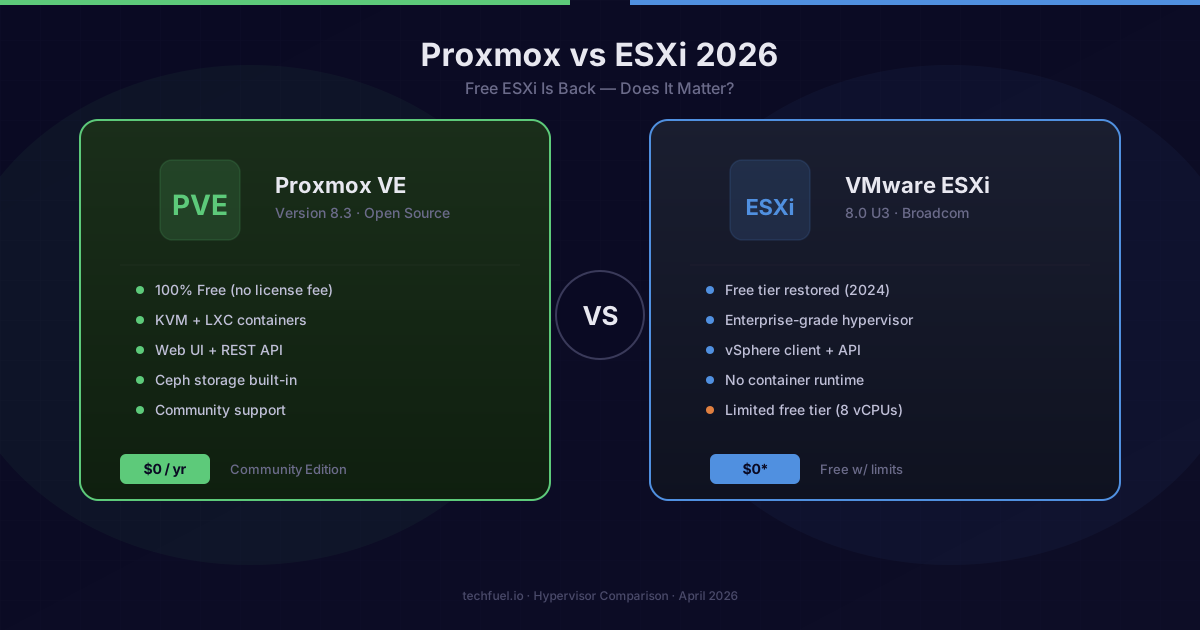
Free ESXi exists again, and it is capped. VMware listed the free edition of vSphere Hypervisor as End of Availability in January 2024, brought it back with ESXi 8.0 Update 3e on April 10, 2025, and has not moved it since. Broadcom's KB 399823, last modified May 18, 2026, still names 8.0 Update 3e, build 24677879 as the free build: at most two physical CPUs per host, at most 8 vCPUs per VM, no vCenter, and no API management of the host. Broadcom's vSphere 9 FAQ says the free version is not made available for 9.0. Proxmox VE 9.2, released May 21, 2026, has none of those limits.
For a new host I pick Proxmox. The harder question is whether to move hosts you already run on ESXi. The migration table below answers it one VMware component at a time.
TL;DR · The 2026 hypervisor call
- New homelab or small-server build: Proxmox VE 9.2. No caps and no licence fee; clustering and KVM plus LXC come in the free install.
- On VVF or VCF, not up for renewal: stay, and count your cores against Broadcom's 16-core-per-CPU minimum before the renewal quote arrives.
- Facing a Broadcom renewal: migrate to Proxmox, after checking the rows of the table below that match what you run.
- VMware certification practice: free ESXi 8.0U3e does the job inside two CPUs, 8 vCPUs per VM and no vCenter, and it gets no later patches without a paid licence.
- Don't: try to cluster free ESXi hosts. The free tier has no vCenter, no vMotion and no HA.
Free ESXi 8.0U3e: unlimited VMs, max 2 physical CPUs per host, 8 vCPUs per VM, no vCenter, vMotion, HA or API management · Proxmox VE 9.2: no caps, free clustering, KVM + LXC, full API · Paid VMware: per core, 16-core minimum per CPU.
The 2026 Reality: Licensing Changed Everything
VMware announced the move from perpetual licences to subscriptions on December 11, 2023. Its End of Availability post of January 22, 2024 lists the standalone vSphere editions, including the free vSphere Hypervisor, as no longer sold.
VMware vSphere Foundation (VVF) and VMware Cloud Foundation (VCF) are priced per physical core with a 16-core minimum per CPU. Broadcom's "Counting Cores" KB 313548 states it plainly: "You must license a minimum of 16 physical cores for each CPU (physical processor) in your ESXi hosts, even if a CPU has fewer than 16 cores." Its own example is three hosts with one 8-core CPU each. They license 48 cores. They have 24. VCF includes 1 TiB of vSAN per core and VVF 0.25 TiB.
What that did to renewals shows up in court filings more than in list prices. AT&T's filing claimed Broadcom offered it a 1,050 percent increase (The Register, October 1, 2024). In a March 2024 Hacker News thread, one commenter reported a customer's $8 million renewal becoming $100 million; another self-reported $66 becoming $3,600.
General support for ESXi 7.x and vCenter 7.x ended on October 2, 2025, per Broadcom's KB 415405.
Proxmox licenses the other way. The software is AGPLv3 and every feature works without a subscription; the optional subscription is per CPU socket, each node in a cluster needs its own at the same level, and it buys the enterprise repository and support. The pricing page lists Community EUR120, Basic EUR370, Standard EUR550 and Premium EUR1,100 per socket per year (read September 26, 2026).
What Free ESXi Actually Gives You (and What It Doesn't)
Free ESXi 8.0 Update 3e is the same production build Broadcom licenses commercially; the licence key is embedded in the free download. Unlimited VMs, no licence fee. The release notes add the terms: no Broadcom support, and "it is for non-production use".
The caps, per KB 399823: a maximum of 2 physical CPUs per host and 8 vCPUs per virtual machine. It cannot be managed by vCenter Server. There is no vMotion, DRS, HA or VADP-based backup, and "usage of APIs to manage hosts is not supported", which rules out Terraform and most Ansible work against the host.
Patches stop at the free build. Broadcom's download KB 372545 names ESXi 8.0 Update 3j (build 25429389) as a later patch and says a version shows up for download only when the account "has an active license for the specific version". With no free ESXi 9, the free path ends at 8.0U3e.
The 8-vCPU ceiling is the cap I would hit first. A domain-controller test VM is fine on 8 vCPUs. A build server that wants 16 threads is not. The free tier will not bend on it. Proxmox VE has no VM, vCPU or feature limits on the free install.
What You Get With Current Proxmox VE 9.2
The current release is Proxmox VE 9.2, dated May 21, 2026, per the official roadmap. It is built on Debian 13.5 "Trixie" with Linux kernel 7.0 as the stable default, QEMU 11.0, LXC 7.0 and ZFS 2.4, and ships Ceph Squid 19.2.3, with Ceph Tentacle 20.2.1 available as a stable option.
Three releases since August 2025 carry the features a VMware migrant asks about. 9.0 (August 5, 2025) added HA affinity rules for keeping guests on, or apart across, chosen nodes, and VM snapshots on shared thick LVM through "snapshots as volume chains", as a technology preview. 9.1 (November 19, 2025) stores a VM's TPM state in qcow2, so VMs with a vTPM can be snapshotted on NFS or CIFS, and added a vCPU flag for nested virtualization. 9.2 added dynamic load balancing in the Cluster Resource Scheduler, which migrates HA-managed guests to even out node load and is the nearest thing Proxmox has to DRS, plus WireGuard and BGP fabrics in the SDN stack and a way to disarm HA cluster-wide for planned maintenance.
None of that sits behind a paywall. Clustering, live migration, HA, the REST API, and LXC containers next to KVM VMs are all in the free install, the set free ESXi lacks. (New to running both? The LXC vs VM in Proxmox guide has the decision tree for picking one per workload.)
| Free ESXi 8.0U3e | Proxmox VE 9.2 (free) | Paid VMware (VVF/VCF) | Proxmox (subscribed) | |
|---|---|---|---|---|
| Price | $0 | $0 | Per core, 16-core/CPU min | EUR120-1,100/yr/socket |
| Physical CPUs/host | Max 2 | No licence cap | No licence cap | No licence cap |
| vCPU cap per VM | 8 vCPUs | No licence cap | No licence cap | No licence cap |
| Updates | Stops at 8.0U3e | No-subscription repo (non-production) | With an active licence | Enterprise repo |
| LXC containers | No | Yes | No | Yes |
| Centralized mgmt | No vCenter | Built-in cluster UI | Managed by vCenter | Built-in cluster UI |
| Live migration | No | Yes (free) | vMotion | Yes |
| API / automation | Not supported | Full REST API | Full API | Full REST API |
| HA / clustering | No | Yes (3 votes) | vSphere HA | Yes (3 votes) |
| Vendor support | None | Community only | Broadcom | Proxmox, Basic and up |
Does Proxmox Actually Run Faster Than ESXi?
For most homelab workloads, no. The hypervisor is not what limits a Jellyfin VM and a stack of Docker containers on a mini PC. Disk and RAM are.
Where a gap shows up is storage throughput on the Linux stack. Storage vendor Blockbridge's NVMe/TCP technote, run on Proxmox VE 7.2 against ESXi 7.0 Update 3c, had Proxmox beat ESXi in 56 of 57 tests with IOPS gains of nearly 50 percent. The storage under both was Blockbridge's own product, and the test is two major versions old on both sides; I read it as a signal about Linux NVMe/TCP rather than a verdict on the hypervisors. It matters if you are building a storage-focused node serving fast NFS over a 2.5GbE or 10GbE network.
After an import, Proxmox's migration guide tells you to choose the CPU type and disk bus, then install the QEMU guest agent. That setup work is covered in the Proxmox setup guide.
Moving From ESXi to Proxmox: What Maps, What Breaks, What It Costs
| VMware piece | Proxmox VE 9.2 counterpart | What breaks or needs work | Extra cost on Proxmox |
|---|---|---|---|
| Host licence: VVF or VCF per core, 16-core minimum per CPU; free ESXi 8.0U3e | Proxmox VE under the AGPLv3, every feature without a subscription | Nothing to convert | EUR0; subscription optional, EUR120-1,100 per socket per year |
| vCenter Server | Any node’s web UI and CLI manage the whole cluster; a REST API sits beside them | Scripts and tools written against the vSphere API | EUR0 |
| vMotion | Live migration inside a cluster (qm migrate --online); qm remote-migrate to another cluster is experimental | Hosts without a cluster: three routes | EUR0 |
| vSphere HA | HA manager: the cluster waits about two minutes, then restarts the failed node’s guests elsewhere | Needs three votes, so two hosts need a QDevice; disks on shared storage | A third machine for the QDevice vote |
| DRS | Dynamic load balancing in the Cluster Resource Scheduler (9.2); HA affinity rules (9.0) | Balances HA-managed guests only | EUR0 |
| vSAN | Ceph (Squid 19.2.3; Tentacle 20.2.1 as a stable option) | The wizard cannot import a VM whose disks sit on vSAN; moving them to another datastore first may work | EUR0 |
| VMFS on an iSCSI or FC LUN | Default layout: shared thick LVM on one big LUN | Snapshots on this layout need “snapshots as volume chains”, a technology preview since 9.0 | EUR0 |
| PVSCSI or LSI controller, VMware Tools | VirtIO SCSI single; QEMU guest agent | Remove VMware Tools before the move; Windows switched to VirtIO SCSI without the driver blue-screens with INACCESSIBLE BOOT DEVICE | EUR0 |
| vmxnet3 NIC on a vSwitch port group | VirtIO NIC on a Linux bridge (vmbr) | New adapter name and MAC: static IPs and DHCP reservations need redoing | EUR0 |
| vTPM, VM encryption | vTPM, with TPM state in qcow2 (9.1) | vTPM state cannot be migrated; encrypted disks cannot be imported. Keep the recovery keys | EUR0 |
| VADP backups | vzdump, or Proxmox Backup Server (incremental, deduplicated, live-restore) | Backup jobs are rebuilt on the new tooling | - |
Read September 26, 2026 from Proxmox's migration guide, roadmap, qm manual and admin guide and Broadcom's KBs; a dash means no source I read prices it.
Before the first import. Proxmox's migration guide walks the import wizard as: add the ESXi host as an import storage, select the VM, click Import, then boot it. The wizard can also live-import, starting the VM while the rest of its disk copies. Proxmox tested the wizard from ESXi 6.5 to 8.0, so an ESXi 9 host is outside that range. A VM with snapshots imports "significantly slower", a datastore name with a character like '+' can break the import, and pointing the wizard at vCenter instead of the host "will dramatically reduce performance". The wizard's connection service limits itself to four parallel connections to the ESXi API, and Proxmox recommends running imports one after another. Note each guest's network settings first: the adapter changes, and Windows warns when you give the new one the old IP.
Windows guests. Uninstall VMware Tools and install the VirtIO drivers while the VM still runs on ESXi. Import with the disk on SATA so the first boot works, attach a small temporary VirtIO SCSI disk so Windows loads the driver, then switch the boot disk over; Proxmox's Windows driver guide says switching without that dummy disk ends in "INACCESSIBLE BOOT DEVICE". The Windows boot guide covers the stop codes if one slips through.
Shared SAN storage. On Fibre Channel or iSCSI, Proxmox's guide starts from one big LUN with shared thick LVM, where a snapshot needs "snapshots as volume chains". That has been a technology preview since 9.0, and the roadmap's next goal is to take it out of preview, so it is still one in 9.2. Design around it before you commit a SAN estate; Blockbridge's qcow2-on-LVM technote shows how it works.
Quorum. A two-host ESXi HA design does not carry over. Proxmox needs three votes, and two nodes get the third from a QDevice. Give corosync its own low-latency network: a node running HA guests that loses quorum reboots when its watchdog times out after 60 seconds, per the HA manager manual. The cluster setup guide has the commands.
The cost line. Broadcom's own example, three hosts with one 8-core CPU each, licenses 48 cores of VVF or VCF at whatever per-core price your quote carries. The same three hosts run Proxmox for EUR0, or EUR360 a year on the Community subscription and EUR1,110 on Basic, one socket per host at list price.
Who Should Use What
Use Proxmox VE 9.2 if:
- You're building a new homelab or small server from scratch in 2026
- You want both KVM VMs and lightweight LXC containers from one interface
- You plan to add a second and third node and want free clustering, live migration and HA
- You want API access for Terraform, Ansible or scripted provisioning without a licence fee
- You're facing a VVF or VCF renewal and the 16-core-per-CPU count no longer makes sense
Use free ESXi 8.0U3e if:
- You're studying for a VMware certification and need hands-on vSphere 8 experience
- You're running enterprise hardware with VMware-certified drivers that would be painful on Linux
- Your host needs at most 2 physical CPUs and 8 vCPUs per VM, and you can do without API management, patches past 8.0U3e and clustering
Keep an existing paid vSphere environment if it is working and you aren't up against a renewal yet.
The Verdict
Free ESXi coming back is good for the ecosystem. Proxmox has rough edges. Post-import settings need review, and snapshots on shared thick LVM still depend on a technology preview.
The gap between the two free tiers is large. Proxmox VE 9.2 gives you containers, clustering, live migration, load balancing, a full API and no CPU or vCPU caps for $0. Free ESXi 8.0U3e gives you a single-host VM platform capped at 2 physical CPUs and 8 vCPUs per VM, with no vCenter, no API management, no HA, no patches past its own build and no free version 9. On the paid side, Broadcom's per-core VVF and VCF licensing with its 16-core-per-CPU floor is what sends shops to the migration table above.
I would install Proxmox. For a new build in 2026 it is not close. Between the two free tiers it is more capable. The KVM and ZFS you learn carry over to real infrastructure work, and so does Linux networking. Coming from ESXi, work down the table, prepare the VirtIO drivers, and import one VM at a time.
Tune the defaults, size the host with the Proxmox hardware guide or the capacity planner, and keep the ZFS ARC guide open if the host runs ZFS.
Speccing a fresh Proxmox host? The PC Builder cross-checks CPU socket and RAM compatibility and PSU size from a CC BY 4.0 parts dataset.
Sources and methodology
Primary sources cited:
- Broadcom KB 399823 — ESXi 8.0 Update 3e free hypervisor — free build 24677879 and its caps (2 CPUs per host, 8 vCPUs per VM, no vCenter, vMotion, HA or API management); modified 2026-05-18
- VMware ESXi 8.0 Update 3e release notes — release date April 10, 2025; free vSphere Hypervisor for non-production use, no Broadcom support
- Broadcom vSphere with VCF 9.0 FAQ (June 2025) — no free version for 9.0; free downloads up to 8.0U3
- Broadcom KB 372545 — download ESXi patches and ISOs — ESXi 8.0 Update 3j (25429389); downloads need an active licence for the version
- Broadcom KB 313548 — Counting Cores for VCF and VVF — 16-core minimum per CPU; the three-host, 48-core example; vSAN TiB per core
- Broadcom KB 415405 — End of General Support for vSphere 7.0 — ESXi 7.x and vCenter 7.x end of general support October 2, 2025
- VMware End of Availability of perpetual licensing (January 22, 2024) — the December 11, 2023 subscription transition; standalone products at End of Availability, including the free vSphere Hypervisor
- Proxmox VE Roadmap — VE 9.0 (2025-08-05), 9.1 (2025-11-19) and 9.2 (2026-05-21) release notes; snapshots as volume chains still a technology preview
- Proxmox VE — Migrate to Proxmox VE — the ESXi import wizard, its tested versions and limits, VirtIO and network preparation, cluster and HA behaviour, shared SAN storage options
- Proxmox VE qm manual — live migration, experimental remote migration and passthrough live migration
- Proxmox VE admin guide — the no-subscription repository
- Proxmox VE pricing — subscription tiers per socket per year (EUR120-1,100)
- Blockbridge — Proxmox VE vs VMware ESXi NVMe/TCP benchmarks — vendor-authored storage testing on Proxmox VE 7.2 and ESXi 7.0 Update 3c
- Blockbridge — QCOW2 snapshots on thick LVM — how snapshots as volume chains work on FC/iSCSI LUNs
- The Register — AT&T claims 1,050% VMware price rise — AT&T court filing on Broadcom licensing
- Hacker News — VMware import wizard and renewal cost reports — self-reported renewal figures, March 2024
Email corrections to contact@techfuelhq.com.
Frequently asked questions
Why is VMware better than Proxmox?
Is Proxmox completely free?
Why are people moving away from VMware?
Can I run Proxmox without a subscription?
What are the disadvantages of Proxmox?
Can I run ESXi on Proxmox?
Does free ESXi 8.0U3e still get patched, and is there a free ESXi 9?
Sources and corrections
- Last updated
- Methodology
- See our methodology for research and review standards.
- Update log
- 2026-09-26 — Pre-cliff pass 28 (gap brief ops/audit/2026-09-22-gemini-thin-content/GAPS/proxmox-vs-esxi-2025.md). Sources read 2026-09-26 14:45-15:02 CDT: Broadcom KB 399823 (modified 2026-05-18), 313548, 372545, 415405, the ESXi 8.0 Update 3e release notes (2025-04-10), the vSphere with VCF 9.0 FAQ (June 2025), Broadcom’s End of Availability post (2024-01-22); the Proxmox roadmap (9.0 2025-08-05, 9.1 2025-11-19, 9.2 2026-05-21), the Migrate to Proxmox VE wiki, the qm manual, the admin guide, the pricing page. Added the migration decision table. Fixed: no built-in DRS (9.2 CRS balancing), no GPU-passthrough live migration (experimental), the ARC surprise on fresh installs (10% capped at 16 GiB since install), the unsourced 2024 free-ESXi end, the unsourced migrator sentiment, the hero’s 8.3, 2024 restore, free-tier API and Community Edition labels.
- 2026-08-22 — Cold claim-citation audit (Goal-5 segment 6), sources re-fetched 2026-08-22. Broadcom KB 399823 (build 24677879, 2 CPUs/host, 8 vCPUs/VM, no vCenter/vMotion/DRS/HA/VADP, API not supported), KB 313548 (16-core minimum quote, 1 TiB / 0.25 TiB vSAN per core), the Proxmox pricing page (EUR120/370/550/1,100 per socket per year), the roadmap (VE 9.2, 2026-05-21, Debian 13.5, kernel 7.0, QEMU 11.0, LXC 7.0, ZFS 2.4, Ceph 19.2.3/20.2.1), The Register (1,050 percent, AT&T court filing) and the Hacker News renewal quotes ($8M to $100M; $66 to $3,600) all read as stated. Two corrections: the Blockbridge technote tested Proxmox VE 7.2 against ESXi 7.0 Update 3c, so the 56-of-57 sentence now carries that scope; and the three-step import description was attributed to the Hacker News thread, which does not contain it - it now cites Proxmox’s Migrate to Proxmox VE wiki, which does, and keeps the HN link for the discussion.
- 2026-07-04 — 2026 SERP-intent rebuild + verify pass: reframed to the head ‘proxmox vs esxi’ intent, corrected Proxmox version to VE 9.2 (2026-05-21, Debian 13.5 / kernel 7.0), grounded all licensing to Broadcom + Proxmox primary pages (free ESXi 8.0U3e caps, 16-core/socket paid minimum, EUR120-1100 Proxmox tiers). Benchmark data point cites the primary Blockbridge NVMe/TCP technote (56-of-57, ~50% IOPS). Three migration gotchas kept as documented Proxmox behavior (VirtIO boot / INACCESSIBLE_BOOT_DEVICE, thick-LVM SAN snapshots with the VE 9 QCOW2-chain tech-preview caveat, 3-node quorum). Adversarial verify: two Reddit threads (1qa8rca, 1kdvay8) could not be re-confirmed via any mirror or archive, so their verbatim quotes, upvote counts, thread citations, and the thread-only NTFS-GUID gotcha were stripped to unattributed textbook substance. AT&T 1,050% figure re-attributed from the wrong HN link to The Register (2024-10-01) as primary. HN dollar figures kept as self-reported anecdotes. Removed the fabricated-precision performance chart.
- 2026-06-19 — 2026 reality refresh: added free-ESXi patch-freeze context, no-free-ESXi-9 dead-end, and Broadcom subscription/bundle licensing context.
- 2026-05-06 — Voice cleanup as part of AdSense hardening pass.
- 2026-04-04 — Initial publish.
- Corrections
- Spotted an error or a stale number? Email contact@techfuelhq.com. Confirmed corrections are added to the update log above.