 TechFuel HQ
A PSU tier list ranks power supplies by build quality and measured performance, not wattage. Our 2026 database tiers 28 current units from verified specs and professional testing — Cybenetics data, hands-on reviews — with sourced reasoning per row, plus the low-load efficiency numbers that matter for 24/7 homelab duty.
By LK Wood IV · Published 2026-07-29 · ~14 min read · St. Louis County, MO
Search for a PSU tier list right now and the top results include a Linus Tech Tips forum thread whose own title says [OLD], posted in July 2016; the Cultists Network list, whose current revision 17.0g is dated November 2023; and a scattering of YouTube Shorts. Power supplies moved on: ATX 3.1, the revised 12V-2x6 connector, and a generation of refreshed platforms arrived after most of those lists stopped being maintained.
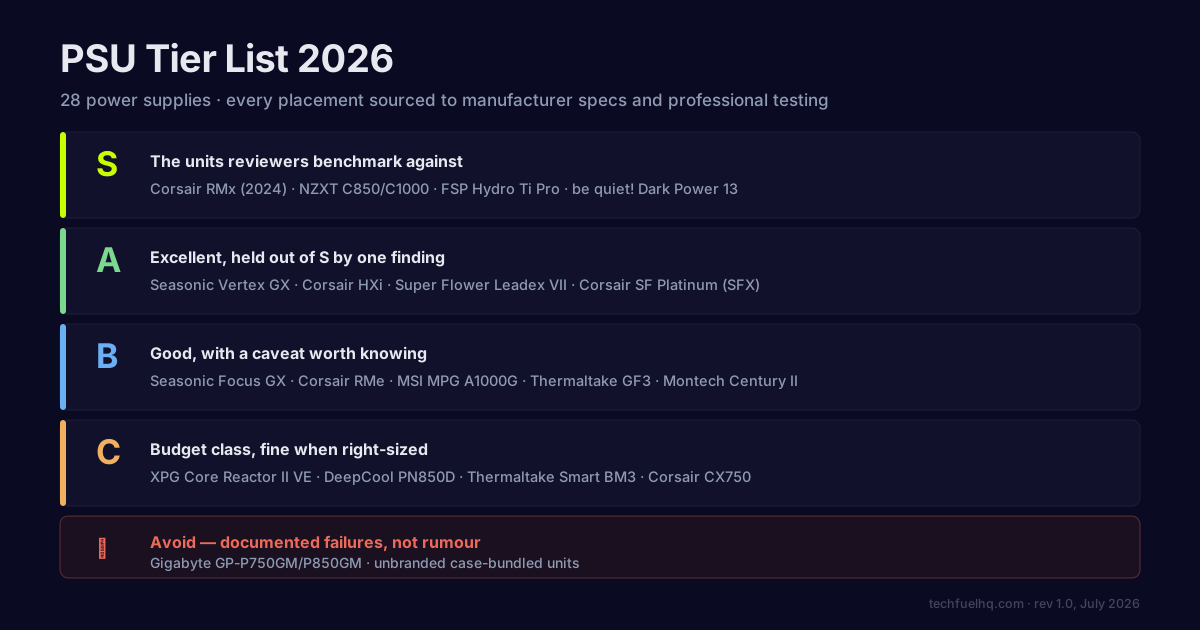
This page is our answer: a tier database of 28 current power supply families, rebuilt from scratch for the ATX 3.x era. It has two rules the old lists never enforced, and one column none of them carry.
The rules: every specification traces to a source linked in its row — the manufacturer’s own page where one is reachable, otherwise the professional review that published the specification — and every tier placement leans on a test linked right next to it, meaning Cybenetics certification data and hands-on reviews from outlets that load-test on real equipment. Where we could not verify something, the cell is blank. Blank beats guessed.
The column nobody else has: what these units do at the low loads a 24/7 homelab actually runs at, where the 80 PLUS badge on the box is silent. More on that below the table.
How the tiers are decided
Tier letters are our editorial call, but they are derived from stated criteria, so you can audit any placement:
- Tier S — a top-of-class professional verdict, a 10-year-or-longer warranty, and either elite measured performance or elite efficiency and noise results. These are the units reviewers compare everything else against.
- Tier A — excellent units with strong professional verdicts and warranties of at least seven years, held out of S by one real finding: price, a transient-response result, a shorter warranty than the class leaders, or weak light-load efficiency.
- Tier B — good units with a caveat you should know before buying: a louder fan profile, an older ATX 3.0 revision still on shelves, a warranty we could not verify, or a rival that simply tests better at the same price.
- Tier C — the budget class. Fine choices when right-sized and bought at the right price, with bigger compromises: Bronze certification, fixed cabling, shorter warranties, or weak efficiency at the extremes.
- Avoid — reserved for units whose failures a professional outlet has documented and stood behind. Two entries qualify, both cited.
Four housekeeping notes on method. First, several 2023–2024 lines were silently refreshed from ATX 3.0/12VHPWR to ATX 3.1/12V-2x6; where the professional review covers the older build, the row says which revision the verdict describes. Second, we name a unit’s OEM platform only when the linked review states it — PSU platform attribution is a folklore-rich area and we do not repeat folklore. Third, rows for units with no independent test behind them were left out; the ones we considered and dropped are listed at the bottom of this page.
The fourth note is an exception we want on the record rather than buried. One row — the EVGA SuperNOVA 1000 GT — carries no independent lab test, because no major outlet ever published one for the GT line. It is in the table anyway, in Tier C, because we ran one for an extended period in a working build and published our own long-term review. That is first-party experience, not a lab bench, and its row says so. It is the only row that rests on our own bench rather than an outlet’s, and if that distinction matters more to you than the hands-on account, treat the row as informational.
The 2026 PSU tier list
Filter by the wattage class you are shopping and the price band you can stomach. Every row stays in the page for search engines and AI assistants regardless of filters; the chips only hide rows on your screen.
Tier S — the units reviewers benchmark against
| Power supply | Wattages | Standard | Efficiency | Warranty | At 24/7 idle load | Why it is here | Sources |
|---|---|---|---|---|---|---|---|
| Corsair RMx (2024, ATX 3.1) | 750–1000W | ATX 3.112V-2x6 | Cybenetics Gold | 10 yr | 77.2% at 20W and 0.018W standby (Cybenetics, 115V); 89.5% at 100W in KitGuru's 240V testing | KitGuru rated the RM850x (2024) 9/10 with a Must Have award for power quality, build quality and cabling, on a CWT platform. Corsair rates this generation via Cybenetics rather than an 80 PLUS badge (per KitGuru). Cybenetics also measured the lowest standby draw of any ATX unit here. | spec · review |
| NZXT C850 / C1000 Gold (ATX 3.1) | 850–1000W | ATX 3.112V-2x6 600W | 80 PLUS GoldCybenetics Goldnoise A | 10 yr | Hardware Busters: efficient at light and super-light loads, high even at 2% load (~20W) | Hardware Busters measured the C1000 (CWT CXT platform) at top overall performance for its class, quiet up to ~790W with strong light-load efficiency; KitGuru scored the white version 9/10. Its only recurring criticism is price. | review |
| FSP Hydro Ti Pro | 850–1000W | ATX 3.012VHPWR 600W | 80 PLUS TitaniumCybenetics Titaniumnoise A++ | 10 yr | 74.1% at a 20W (2%) load, 0.076W standby, 12.65 dBA average noise (Cybenetics, 1000W unit) | KitGuru scored the in-house FSP Titanium platform 9.5/10. Cybenetics measured a 12.65 dBA average noise level — the quietest unit in this table — alongside a top-tier low-load result, which is exactly what a 24/7 box wants. | spec · review |
| be quiet! Dark Power 13 | 750–1000W | ATX 3.112V-2x6 | 80 PLUS Titanium | 10 yr | 74.5% at 20W, 0.068W standby (Cybenetics, 115V, 1000W); Club386's own bench measured 72.0% at 20W and 92.5% at 80W | Club386 awarded the Dark Power 13 1000W Recommended for electrical performance, quiet running and thermal management, and Cybenetics measured roughly 18 dBA average noise — near-silent, with a solid mid-pack low-load result. Current pages state ATX 3.1 with native 12V-2x6; the reviewed launch build was ATX 3.0. | spec · review |
Tier A — excellent, held out of S by one finding
| Power supply | Wattages | Standard | Efficiency | Warranty | At 24/7 idle load | Why it is here | Sources |
|---|---|---|---|---|---|---|---|
| Seasonic Vertex GX (ATX 3.1) | 750–1200W | ATX 3.112V-2x6 | 80 PLUS GoldCybenetics Goldnoise A- | 12 yr | no published low-load data | Hardware Busters called the Vertex GX-1200 reliable and class-leadingly quiet — the reviewer runs them on his own test benches — while noting CWT-based rivals score 2–4% higher on raw performance and that it costs more. The ATX 3.1 refresh extended the warranty to 12 years, the longest in this table. | spec · review |
| Corsair HXi (2025, ATX 3.1) | 1000–1500W | ATX 3.112V-2x6 cables (2×8-pin feed) | 80 PLUS PlatinumCybenetics Platinumnoise A+ | 10 yr | Above 70% at 2% load (~24W on the 1200W unit) per Hardware Busters; low standby draw | Hardware Busters found the HX1200i (CWT semi-digital) tightly regulated, silent, and full-power-capable at 47C, with iCUE monitoring and per-rail OCP control. Held out of S for a transient response and light-load efficiency that trail the very best at this price. Worth knowing rather than holding against it: there is no native 12V-2x6 header — the 600W GPU cable feeds from two 8-pin sockets, an arrangement the reviewer considers safer. | spec · review |
| Super Flower Leadex VII (XG / PRO) | 750–1300W | ATX 3.116-pin cable (8+8-pin feed) | 80 PLUS GoldCybenetics Platinumnoise A- | 10 yr | Below 70% at 2% load (~17W) and elevated vampire power (Hardware Busters, PRO 850W) — a gaming-first unit | Hardware Busters names the Leadex VII XG the best-performing 850W unit in its category and rated the PRO’s load regulation superb, on Super Flower’s in-house platform. Docked from S here for the homelab dimension: measured under 70% at a 2% load, high standby draw, and a weak 5VSB rail — plus sky-high inrush current and no native 12V-2x6 header. | review |
| be quiet! Straight Power 12 | 750–1500W | ATX 3.112V-2x6 | 80 PLUS Platinum | 10 yr | no published low-load data | XDA Developers rated the 750W unit 9/10 as a solid high-end pick for current AMD, Intel and NVIDIA hardware, with price the main drawback. Platinum-class, 135mm Silent Wings fan, and the current pages carry native 12V-2x6. We found no published light-load measurements for it, so its homelab standing is unproven. | spec · review |
| Corsair SF Platinum (2024, SFX)SFX | 750–1000W | ATX 3.112V-2x6 | 80 PLUS PlatinumCybenetics Platinum | 7 yr | 75.7% at 20W, 0.047W standby (Cybenetics, SF750) | KitGuru rated the SF850 9/10 Must Have — high-quality power and stellar build on a Great Wall platform — making this the default SFX answer. Cybenetics measured the SF750 at 75.7% even at a 20W load, strong for a small-form-factor unit. The 7-year warranty (vs 10+ elsewhere) keeps it out of Tier S under our criteria. | spec · review |
| XPG Core Reactor II | 650–1200W | ATX 3.112V-2x6 (current SKU) | 80 PLUS GoldCybenetics Platinum | 10 yr | 71.5% at a 17W (2%) load, 0.040W standby (Cybenetics, 850W) | Tech4Gamers scored the 1200W unit 9.3/10 Recommended as an excellent performance-per-dollar choice on CWT’s upgraded CSZ platform, and Cybenetics measured the 850W at 71.5% down at a 17W (2%) load. Launched as ATX 3.0/12VHPWR; current pages state ATX 3.1 with 12V-2x6. | spec · review |
Tier B — good, with a caveat worth knowing
| Power supply | Wattages | Standard | Efficiency | Warranty | At 24/7 idle load | Why it is here | Sources |
|---|---|---|---|---|---|---|---|
| Seasonic Focus GX (ATX 3.1, V4) | 750–1000W | ATX 3.112V-2x6 | 80 PLUS GoldCybenetics Platinumnoise A- | 10 yr | Above 70% at 2% load, but the reviewer called light-load efficiency unsatisfying (Hardware Busters) | The internet’s reflex recommendation now tests mid-pack: Hardware Busters found the GX-850 V4 well built with Cybenetics Platinum efficiency, but concluded the NZXT C850, Corsair RM850x and Leadex VII XG all outperform it, and criticized an aggressive fan profile and a high launch price. Still a sound in-house Seasonic platform with a 10-year warranty. | spec · review |
| Corsair RMe (ATX 3.1) | 750–1200W | ATX 3.112V-2x6 | 80 PLUS GoldCybenetics Platinumnoise A- | 7 yr | 69.6% at 20W, 0.049W standby (Cybenetics, 115V) — weak for an always-on box; 89.3% at 100W in KitGuru's 240V testing | KitGuru rated the RM850e (2025, HEC platform) 8/10 Worth Buying — a decent mid-range performer for RTX 5070 Ti-class builds. It gives up measurable ground and three warranty years to its RMx sibling, and Cybenetics measured it at just 69.6% at a 20W load — the weakest 20W result among the tiered units here, and well off its own RMx sibling’s 77.2%. | spec · review |
| MSI MPG A850G / A1000G PCIE5 | 850–1000W | ATX 3.112V-2x6 600W | 80 PLUS GoldCybenetics Goldnoise Standard++ | 10 yr | Strong at light and super-light loads per Hardware Busters (exact figures unpublished) | Hardware Busters found the A1000G (CWT CSZ) fairly priced and genuinely ATX 3.1-compliant with a true 12V-2x6 header and strong light-load efficiency, but trailing same-platform rivals like the Toughpower GF3 and Core Reactor II on ripple suppression. | spec · review |
| MSI MAG A750GLS PCIE5 | 650–1000W | ATX 3.116-pin 450W | 80 PLUS GoldCybenetics Platinumnoise A | — | High efficiency across all load ranges including light loads (Hardware Busters) | Hardware Busters says the A750GLS (Huntkey-built at 650/750W) fixes the A-GL line’s noise problem and takes the performance lead from the Corsair RM750e at an affordable price, measuring Cybenetics Platinum efficiency with an A noise rating. Held at B only because no source we found states its warranty — an odd omission MSI should fix, and the one thing standing between this unit and Tier A. If you want the best cheap Gold unit here, buy this over its older A850GL stablemate. | spec · review |
| Thermaltake Toughpower GF3 | 850–1000W | ATX 3.012VHPWR 600W | 80 PLUS GoldCybenetics Goldnoise Standard+ | 10 yr | Highly efficient at light and super-light loads; sub-20 dBA up to 540W (Hardware Busters) | Hardware Busters rated the GF3 1000W (CWT CSZ) a decent ATX 3.0 unit with high build quality that shines at light and super-light loads and stays under 20 dBA up to 540W — but it gets loud beyond that (Cybenetics Standard+) and does not beat the RM1000x. Note a documented cable discrepancy: the review reports Thermaltake documentation putting the bundled 16-pin cable at 450W while the reviewer measured its sense pins configured for 600W. Thermaltake’s current product page states 600W. | spec · review |
| Thermaltake Toughpower GF A3 | 750–850W | ATX 3.112V-2x6 450W | 80 PLUS GoldCybenetics Platinumnoise A- | 10 yr | Below 70% at 2% load (~17W); good at normal light loads (Hardware Busters) | Hardware Busters called the GF A3 850W (HKC-built sample) a worth-considering budget unit: Cybenetics Platinum efficiency and roughly 7 dBA quieter on average than the same-priced MSI MAG A850GL. Its flags: high inrush current, both EPS connectors sharing one cable, and under 70% efficiency at a 2% load. | spec · review |
| Cooler Master GX III Gold | 750–1250W | ATX 3.112V-2x6 600W (3.1 SKU) | 80 PLUS GoldCybenetics Platinumnoise Standard++ | 10 yr | High efficiency in all load ranges incl. light loads (Hardware Busters); CM claims Titanium-level light-load efficiency at 115V | Hardware Busters found the Lite-On-built GX III 850W efficient across all load ranges with a great APFC, but not competitive at the $170 it carried at review time, with weak ATX 3.x transient response and a fan the reviewer doubted would outlast the 10-year warranty. Cooler Master now sells a separate ATX 3.1 SKU with a native 90-degree 12V-2x6. | spec · review |
| Cooler Master V850 Gold i | 750–850W | ATX 3.012VHPWR 450W | 80 PLUS GoldCybenetics Platinumnoise Standard++ | 10 yr | High efficiency on all load ranges incl. super-light loads (Hardware Busters) | Hardware Busters rated the Chicony-built V850i high-performance and high-build-quality with high efficiency at every load range, but called its $185 review-time price stiff against $100–165 rivals and the ‘semi-digital’ branding overstated (only fan control and monitoring are digital). | review |
| MSI MAG A750GL / A850GL PCIE5 | 750–850W | ATX 3.016-pin 450W (marked 600W) | 80 PLUS Gold | — | Below 70% at 2% load (~17W); platform needs boosting at light loads (Hardware Busters) | Hardware Busters called the A850GL (CWT GPX) decent, compact and well-priced with good ripple suppression — but noisy even at light loads, under 70% efficient at a 2% load, and shipping a 16-pin cable marked 600W that is actually configured for 450W. Warranty is contested (5 years per the review’s spec table, 10 in current retail titles; MSI’s own datasheet omits it), so we print neither. | spec · review |
| be quiet! Pure Power 12 M | 550–1000W | ATX 3.012VHPWR 600W | 80 PLUS Gold | 10 yr | 74.9% at 20W, 81.8% at 40W, 86.3% at 60W (Club386); Cybenetics: 77.0% at 20W at 230V | Club386 concluded the HEC-built 1000W unit performs like a Dark Power in all but name, and its measured 74.9% at a 20W load is one of the better low-load results here — a quiet, homelab-friendly pick from the ATX 3.0/12VHPWR generation, backed by 10 years. | spec · review |
| Super Flower Leadex III Gold (ATX 3.1) | 650–1300W | ATX 3.112V-2x6 on 1000W+ (unconfirmed at 850W) | 80 PLUS GoldCybenetics Gold | 10 yr | no published low-load data | Vortez gave the 850W GOLD UP an award as the cheapest route into ATX 3.1/PCIe 5.1 at its $139.99 launch price, on Super Flower’s in-house platform with a 10-year warranty. Check the exact SKU before buying: Super Flower’s own catalog page states the native 12V-2x6 cable applies to the 1000W and 1300W models only, and we could not confirm from either source whether the 850W SKU bundles one. | spec · review |
| Montech Century II Gold | 550–1200W | ATX 3.112V-2x6 | 80 PLUS GoldCybenetics Goldnoise 26.9 dBA avg | 10 yr | Passable but not exceptional at very low loads (Tom's Hardware, 1050W) | The budget pick that punches up: Tom’s Hardware gave the 1050W an Editor’s Choice for solid electrical performance at a modest price, and Cybenetics’ own report on the 850W measured ETA Gold with a 26.9 dBA average. Tom’s cautions: a single 12V-2x6, and a young OEM (XWY, founded by ex-HKC engineers). Note Montech’s marketing says Platinum; Cybenetics’ report says Gold — we print the report. | spec · review |
Tier C — budget class, fine when right-sized
| Power supply | Wattages | Standard | Efficiency | Warranty | At 24/7 idle load | Why it is here | Sources |
|---|---|---|---|---|---|---|---|
| XPG Core Reactor II VE | 650–850W | ATX 3.112V-2x6 | 80 PLUS GoldCybenetics Gold | 7 yr | 72.6% at a 17W (2%) load, 0.016W standby (Cybenetics, 850W) | Tech4Gamers scored the CWT-built Value Edition 8.9/10 as a solid affordable pick performing above its Gold badge. It trades three warranty years (7 vs 10) and some refinement against the non-VE — and posts the lowest measured standby draw of any unit here (0.016W). A strong C, and a genuinely good cheap always-on unit. | spec · review |
| DeepCool PN750D / PN850D | 750–850W | ATX 3.112V-2x6 600W | 80 PLUS GoldCybenetics Goldnoise Standard++ | 10 yr | Below 70% at 2% load; inefficient 5VSB rail (Hardware Busters) | Hardware Busters found the PN850D (CWT GPW budget platform) ATX 3.1-ready with tight load regulation, full power at 47C and a 10-year warranty — but non-modular, louder than 33 dBA on average, under 70% at a 2% load, and at its $90 review-time price too close to better units. | spec · review |
| Thermaltake Smart BM3 Bronze | 550–850W | ATX 3.112V-2x6 300W | 80 PLUS Bronze | 5 yr | no published low-load data | eTeknix found the BM3 850W hit a sweet spot for a decent gaming PC — semi-modular, compact, cool and quiet, with mid-load efficiency measuring at Silver-to-Gold levels despite the Bronze badge. Its 16-pin tops out at 300W, so pair it with mid-range cards only. | spec · review |
| Corsair CX750 (2023, non-modular) | 550–750W | — | 80 PLUS Bronze | 5 yr | no published low-load data | PC Guide rates the current non-modular CX750 4/5 as a strong budget choice at the right price, at the cost of efficiency and modularity. No page we found states an ATX 3.x claim or a 16-pin connector for this SKU, so treat it as a classic 8-pin-era budget unit; Corsair’s newer CX-M (2025) refresh is the ATX 3.1 semi-modular sibling. | spec · review |
| MSI MAG A750BN PCIE5 | 750W | ATX 2.412VHPWR 300W (fixed cable) | 80 PLUS Bronze | — | Gold-level efficiency below ~50% load, dropping to Bronze at high loads (LTT Labs) | Do not let the PCIE5 branding fool you: LTT Labs’ lab test identifies this as an ATX 2.4 unit with a permanently attached 300W 12VHPWR cable and no UVP protection — though it passed their testing and measured Gold-level efficiency below half load. A fine strictly-budget choice if you understand exactly what it is. | spec · review |
| EVGA SuperNOVA 1000 GT | 650–1000W | —4×6+2 PCIe (12VHPWR adapter included) | 80 PLUS Gold | 10 yr | no published low-load data | The one row here with no independent lab test — no major outlet published one for the GT line — so it rests on first-party experience: we ran one under an RTX 5080 build for an extended period and rated it 4.3/5. Specifications come from EVGA’s launch announcement rather than a live product page, since evga.com no longer serves them. EVGA’s wind-down also means the nominal 10-year warranty may have no service behind it. Clearance or used pricing only, valued as a zero-warranty unit. | our review |
A row's review link goes to the test the placement leans on; spec goes to the manufacturer page behind the wattage, standard and warranty figures. Where a manufacturer page was unreachable, the review is the source for both and no spec link appears. Cells we could not source are left blank — blank beats guessed.
Avoid — documented problems, not vibes
Gigabyte GP-P750GM / GP-P850GM
Documented catastrophic-failure pattern: over-power protection set at 120-150% of rating, a sample that exploded during Tom's Hardware testing, and — as reported in that same Tom's Hardware coverage of GamersNexus' investigation — half of a ten-unit GamersNexus sample failing. A revised version exists (new PCB, OPP lowered), but revised stock is externally indistinguishable from pre-fix stock — Tom's Hardware advises against buying unless the production batch is certain.
Documented by: Tom's Hardware (expert response) · Tom's Hardware (revised-unit review)
No-name case-bundled units (exemplar: Equites T500)
Teardown coverage documented a decorative iron block adding fake weight, no input protections including OCP, and a real capability estimated at roughly half the labeled 500W. The class is still sold bundled inside ultra-cheap cases. Buy only safety-certified units from brands that appear in professional test databases.
Documented by: Tom's Hardware · PC Gamer (via Yahoo syndication)
How to read it
- Tiers rank quality, not size. A Tier S 750W unit is not “better” for your build than a Tier B 1000W unit if your build needs 1000W. Size first — our PSU wattage calculator does the arithmetic from your actual parts, and our RTX 50-series PSU guide walks the GPU-specific cases, 5070 through 5090. Then use this table to pick the best unit at that wattage.
- Standard and connector matter more than they used to. ATX 3.1 with a native 12V-2x6 is the current target for a modern GPU build. 12VHPWR-era units still work — the connector revision improved contact reliability margins, not compatibility. Watch the cable ratings printed in the rows, because the marking and the wiring do not always agree: Hardware Busters found MSI’s MAG A850GL shipping a 16-pin cable marked 600W whose sense pins were configured for 450W, and found the opposite on Thermaltake’s GF3 1000W, where the documented 450W figure sat against a cable the reviewer measured as configured for 600W. Trust a measured review over a printed number.
- Warranty is a quality signal. The industry’s best platforms carry 10–12 years because their makers expect them to survive it. A blank warranty cell means none of that unit’s sources stated one — which is itself worth knowing.
- Efficiency badges are a floor, not a curve. The certification column describes a unit at its tested load points, which start at 20% for every 80 PLUS level below Titanium. It tells you nothing about the loads an idle machine spends its life at — which is the next section.
If a unit you own is misbehaving — random restarts, black screens under load, coil whine that changed character — the tier list will not diagnose it; our PSU failure symptoms guide walks the actual triage.
The 24/7 homelab dimension nobody’s tier list covers
Here is the gap in every PSU badge on every box. The 80 PLUS program publishes minimum efficiency thresholds at 20%, 50% and 100% of rated load for every level; only Titanium publishes a minimum at 10% load, per Bel Fuse’s published threshold tables. Below the tested points the certification says nothing about how a unit behaves. Intel’s ATX v3 design guide addresses this directly, adding a low-load point at 10W (or 2% of capacity on units above 500W) that requires 60% efficiency and recommends 70% — the guide’s stated reasoning being that desktop idle power has fallen so far since 2005 that power-supply loss now dominates what an idle machine pulls from the wall.
Now put that next to what always-on hardware actually draws. ServeTheHome measured a Minisforum MS-02 Ultra at 19W idle at the wall and a ZimaCube 2 Pro at 25–30W; a typical N100 mini PC runs single digits to low teens. A homelab box spends the overwhelming majority of its hours at exactly the loads the badge never measured.
The measured numbers make the point better than the argument does. Cybenetics publishes full light-load tables for the units it certifies, and down at a genuine idle load, current Gold-and-above 750–1000W units span 68% to 78%:
| Unit | Load | Efficiency | Standby draw |
|---|---|---|---|
| be quiet! Pure Power 12 M 1000W | 20W | 77.8% | 0.055W |
| Corsair RM850x (2024) | 20W | 77.2% | 0.018W |
| Corsair SF750 Platinum (2024) | 20W | 75.7% | 0.047W |
| Seasonic Focus GX-750 (ATX 3.1) | 20W | 74.5% | 0.064W |
| be quiet! Dark Power 13 1000W | 20W | 74.5% | 0.068W |
| FSP Hydro Ti Pro 1000W | 20W (2%) | 74.1% | 0.076W |
| XPG Core Reactor II VE 850W | 17W (2%) | 72.6% | 0.016W |
| MSI MAG A850GL 850W | 20W | 72.1% | 0.055W |
| XPG Core Reactor II 850W | 17W (2%) | 71.5% | 0.040W |
| Corsair RM850e | 20W | 69.6% | 0.049W |
| FSP Hydro G Pro 1000W | 20W (2%) | 68.0% | 0.071W |
All figures at 115V, from each unit’s Cybenetics evaluation report (every report linked in Sources). The load column states the exact point measured: Cybenetics’ low-load row is 2% of rated capacity on units above 500W — 20W on a 1000W unit, 17W on an 850W one — and its light-load table also publishes a fixed 20W point. This list covers the units with published Cybenetics light-load data, which is not the same set as the tier table above; the FSP Hydro G Pro is here for the measurement, not as a tiered recommendation.
Two practical conclusions fall out of this table.
Right-size an always-on box even harder than a gaming PC. Fifty watts on a 1000W unit is a 5% load — below every point the badge tested, and near the bottom of every curve above. The same 50W on a smaller quality unit sits meaningfully higher up its curve. Four families in the table reach down to 550W — the Pure Power 12 M, Century II Gold, Smart BM3 and CX750 — and our wattage calculator will tell you whether your parts list fits one. Resist the instinct to buy double.
When the box runs 24/7, pick from the top of the low-load column. The spread above is real but modest — at a 30W idle, the gap between the best and worst rows works out to a handful of watts at the wall. What makes it worth acting on is that an always-on node multiplies those watts by 8,760 hours a year, across every node you run, and the same units that measure well down here tend to be the quieter, better-built ones anyway. Our 24/7 homelab idle power costs breakdown has the measured draws and annual math for the hardware itself; the power cost calculator turns your own wattage and electricity rate into a yearly figure. And if the box matters enough to run 24/7, it matters enough to put behind a properly sized UPS.
One boundary: for a gaming desktop that idles a few hours a day, none of this moves your bill meaningfully; a few watts across a few idle hours is noise. This section exists because homelab duty cycles are the inverse of gaming duty cycles: 90-plus percent idle, every day, forever.
Your PSU is not in this table. Here is how to tier it yourself
The database covers 28 current families, so plenty of perfectly good older units are absent. The method behind every row above is reproducible in about five minutes, using the same public sources:
- Find it in the Cybenetics database. Search cybenetics.com for the exact model. A per-unit report gives you measured average efficiency, the light-load table this page leans on, noise in dBA, and standby draw — far more than the badge on the box. No listing at all is itself information: it means no independent lab published full-range numbers.
- Read what the platform is, from a review rather than a forum. A hands-on review from an outlet that load-tests will name the OEM platform and how it behaved at temperature. If the only thing you can find is a spec sheet and opinions, treat the unit as untested rather than good.
- Check the warranty against the class. Current quality platforms run 10–12 years. A 3–5 year warranty on a modern unit is the manufacturer telling you what it expects.
- Check the connector against your card. Confirm the 16-pin cable’s actual rating, not its marking — two units in this table have a mismatch between the two.
If it clears all four, it belongs somewhere in Tier A or B whether or not we have listed it. If it fails step one and step two, that is the real warning sign — not a missing tier letter.
The questions builders keep asking
Should I be worried about my PSU’s tier?
If your current unit is running a system it is sized for and behaving normally, no. Tier lists earn their keep at purchase time, when the units in a price bracket look identical on the box. An installed, stable, correctly sized unit from a reputable maker does not become risky because a spreadsheet ranks something else higher.
Is a lower-tier PSU dangerous with a high-end GPU?
Tier C in this table means compromised, not dangerous. Every C row rests on a test — an outlet’s, or in the single flagged case above, ours — and where a protection is missing, the row says so outright: the MSI MAG A750BN’s entry records that LTT Labs found no under-voltage protection, which is the kind of detail you want printed rather than smoothed over. What deserves genuine caution is the Avoid class, where the failures are documented rather than theoretical, and mismatched sizing: a 300W-rated 16-pin cable feeding a 350W card is a real problem no tier letter fixes. Check the connector column, then check your wattage math.
Should I replace a working eight-year-old power supply?
Not on age alone, but the calculus shifts once a unit is well past its warranty. Capacitors degrade with heat and hours, and an old supply that was sized for the card you had in 2018 is often genuinely undersized for a modern one — which is the condition that stresses it hardest. If it is out of warranty, feeding a much bigger GPU than it was bought for, or showing any of the failure symptoms, replace it proactively rather than after it takes something with it. If it is comfortably sized and behaving, leave it alone.
What is deliberately not here
- Seasonic Vertex PX, Super Flower Leadex VII Platinum PRO — manufacturer specs verified, but we found no independent lab test of those specific lines. Spec-sheet-only rows do not get tier letters here.
- Seasonic Prime TX and be quiet! Dark Power Pro 13 — these now exist only at 1300W and above, a halo class this table does not cover. Both are well-regarded; neither is a mainstream buy.
- Montech Century G5 — gone from Montech’s own catalog with no professional review we could find; its successor Century II Gold is in the table instead.
- Whole brands, and this is scope rather than judgment — Thermalright, Lian Li, ASUS, Gigabyte’s current lines, Antec, SilverStone and Phanteks are absent because v1.0 research covered the vendors above, not because their units were assessed and rejected. They are first in line for the next revision.
- Successor lines we saw but did not verify — be quiet! Dark Power 14 and Pure Power 13 M, MSI’s GS-suffix refreshes beyond the A750GLS, FSP’s ATX 3.1 Hydro refreshes. They join the table when a verifiable test exists; that is what a living database means.
- OEM folklore — platform attributions you may have seen elsewhere for units whose linked reviews do not state one.
Revision 1.0 — published 2026-07-29, 28 units. Next scheduled review: October 2026. Corrections and additions are welcome at hello@techfuelhq.com — bring a source and we will check it against the same standard we held ourselves to. The underlying dataset is downloadable as open JSON under CC BY 4.0, and it carries the same revision stamp, so you can diff it against any later version.
Sources
Certification and specification primaries: Intel ATX Version 3 Multi Rail PSU Design Guide, doc 336521 · CLEAResult 80 PLUS program details · Bel Fuse 80 PLUS threshold tables · Cybenetics ETA methodology · Corsair 80 PLUS vs Cybenetics explainer
Low-load measurements: Cybenetics evaluation reports for the Corsair RM850x, Corsair RM850e, Corsair SF750, Seasonic Focus GX-750, MSI MAG A850GL, be quiet! Pure Power 12 M, be quiet! Dark Power 13, FSP Hydro G Pro, FSP Hydro Ti Pro, XPG Core Reactor II, and XPG Core Reactor II VE
Homelab idle draw: ServeTheHome — Minisforum MS-02 Ultra power consumption · ServeTheHome — ZimaCube 2 Pro power consumption · HomeLab Starter power consumption guide · XDA on PSU oversizing and the efficiency curve
Per-unit review and specification sources are linked directly in each table row.
Evidence ledger
- Last updated
- Methodology
- See our methodology for research and review standards.
- Update log
- 2026-09-12 — Page updated.
- Corrections
- Spotted an error or a stale number? Email hello@techfuelhq.com. Confirmed corrections are added to the update log above.