 TechFuel HQ
By LK Wood IV · 2026-06-13 · ~12 min read · St. Louis County, MO
Running a 360W card 24/7 for AI inference sounds like a bad idea on paper. In practice, the RTX 5080’s architecture makes it more nuanced than the TDP number suggests. This article looks at what actually happens to power draw and throughput under inference workloads, and whether the 5080 makes sense as an always-on inference node or whether a lower-TDP card is the smarter play.
How LLM inference loads a GPU differently than gaming
Gaming workloads run the GPU’s shader cores at high utilization continuously. Textures, geometry, and lighting calculations keep the CUDA cores and tensor cores busy, which drives power consumption toward TBP (Total Board Power).
LLM inference — generating tokens with a large language model — has a fundamentally different workload profile:
Memory bandwidth-bound, not compute-bound. For single-user interactive inference with models near the card’s VRAM ceiling (the 14B–24B class on a 16GB card), the GPU’s primary bottleneck is reading model weights from VRAM to the CUDA cores for each token generation pass. The CUDA cores sit idle while the memory controllers read the next chunk of model weights.
Result: the GPU never reaches full shader utilization for single-user inference. GPU utilization in monitoring tools typically shows 40–70% for large-model inference. Power draw runs well below TBP.
For the RTX 5080 running Mistral Small 24B Q4_K_M (a ~14GB file, the largest class that fits) in single-user interactive mode:
- GPU power: 180–250W (not 360W)
- GPU core clock: auto-clocks down (less shader demand)
- Memory bandwidth: near-saturated (this is the bottleneck)
- GPU temp: 65–75°C junction (comfortable for the ROG Astral’s cooling)
The consistent picture from community measurements (r/LocalLLaMA, TechPowerUp threads) and the bandwidth math: the RTX 5080 draws significantly less than TBP during interactive inference. The 360W TBP represents maximum shader + memory simultaneous load (like a heavy rasterization gaming scene) — inference doesn’t hit both simultaneously.
One honest correction from my own bench: those community ranges run low for this card. My measured single-stream decode landed at 265–344W with 82–93% reported utilization (table below) — an OC variant with a 448W limit boosting to 3.2GHz+ under load draws more than the reference-card figures the threads describe. The “well below TBP” conclusion survives; the absolute wattage people plan around should come from the measured table, not the forum ranges.
Measured: single-stream inference power on my own card
On 2026-08-20 I measured this directly instead of estimating: 1Hz nvidia-smi board-power telemetry during ollama decode on my ROG Astral RTX 5080 OC, four models, three fresh-prompt iterations each, loaded-basis medians (samples at ≥50% GPU utilization only). The full method, raw per-run CSVs, and joules-per-token table live in the RTX 5080 LLM power-efficiency dataset; the decode-rate canon for this card is the throughput dataset.
| Model | Decode tok/s | Board W (loaded med) | Tokens/joule | $ per 1M tokens* |
|---|---|---|---|---|
| Llama 3.2 3B (Q4_K_M) | 318.3 | 265.2 | 1.20 | $0.043 |
| Qwen 2.5 7B (Q4_K_M) | 182.2 | 343.6 | 0.53 | $0.096 |
| Qwen 2.5 14B (Q4_K_M) | 98.8 | 311.6 | 0.32 | $0.161 |
| gpt-oss 20B (MXFP4, MoE) | 194.4 | 292.4 | 0.67 | $0.077 |
*Board power only, at the $0.184/kWh EIA US residential average (May 2026).
The headline: board power stayed inside a narrow 265–344W band across a 7x parameter spread — the card never touched its 448W limit — while tokens-per-joule varied 4x, and the sparse-MoE 20B beat the dense 7B on efficiency. The single-user power story is “roughly 300W whenever it’s decoding, and the model choice sets how many tokens that buys.”
Throughput vs power at scenarios I have not yet measured
These figures are derived from architecture analysis and community measurements from inference community benchmarking threads (TechPowerUp forums, Reddit r/LocalLLaMA) — not fabricated specific numbers, but representative ranges:
Single-user interactive inference (Mistral Small 24B Q4_K_M, 8K context):
- Throughput: 30–45 tokens/second (bandwidth-bound estimate: ~960 GB/s over a ~14GB weight file)
- Estimated GPU power during inference: 180–250W
- Tokens per watt: ~0.15–0.2 tok/W
Batch inference (4–8 simultaneous requests, 24B Q4):
- Throughput: 70–130 tokens/second total across batches
- Estimated GPU power: 280–360W
- Tokens per watt: ~0.25–0.4 tok/W
Small model, high throughput (Llama 3.1 8B Q4, full batch):
- Throughput: 200+ tokens/second
- GPU power: 150–250W
- Tokens per watt: ~0.8–1.3 tok/W
The small model scenario shows why throughput/watt metrics vary so dramatically: the 8B model at high batch uses the GPU compute efficiently while keeping power below TBP. The 24B model is almost entirely memory-bandwidth-limited.
GDDR7 architecture advantage
The RTX 5080’s shift to GDDR7 memory (versus the RTX 4090’s GDDR6X) affects inference performance in a specific way.
GDDR6X used PAM4 (Pulse Amplitude Modulation with 4 levels) signaling to achieve high bandwidth at relatively lower clock speeds. GDDR7 moved to PAM3 (three-level) signaling per the JEDEC spec — trading fewer levels per symbol for better signal integrity at higher rates, delivering more bandwidth per memory die at lower voltage.
Bandwidth per watt improves. The GDDR7 on the 5080 achieves approximately similar total bandwidth to the 4090’s GDDR6X (~960 GB/s vs ~1008 GB/s) while consuming less power per GB/s delivered. For inference — which is bandwidth-dominated — this is the relevant metric.
16GB ceiling. The 5080 has 16GB GDDR7, not 24GB. For models quantized to fit in 16GB (up to the ~24B class at Q4; Gemma 3 27B is the marginal case), this works. For anything bigger — 27B at comfortable quants, 32B, and especially the 70B class (a ~42GB file at Q4) — the 16GB ceiling is the hard bottleneck and you’d need a 4090/5090, dual GPUs, or slow CPU offload.
Power limit reduction for 24/7 efficiency
The RTX 5080 at 90% power limit (324W ceiling):
- Interactive inference throughput: ~5–10% reduction (memory-bandwidth-limited, power limit rarely hits)
- Batch inference throughput: ~10–15% reduction (starts hitting the ceiling under full batch)
- Temperature reduction: 5–8°C under sustained load
- Electricity savings at 24/7 operation: 36W × 8760 hours = 315 kWh/year = ~$58/year at the $0.184/kWh US average (EIA, May 2026)
Combined with the undervolt approach (see the RTX 5080 undervolt guide), you can achieve similar power floor with better clock stability than a blunt power limit reduction. An undervolted 5080 at 925mV running at 2750MHz draws less power at equivalent clocks than a stock 5080 throttled by a power limit.
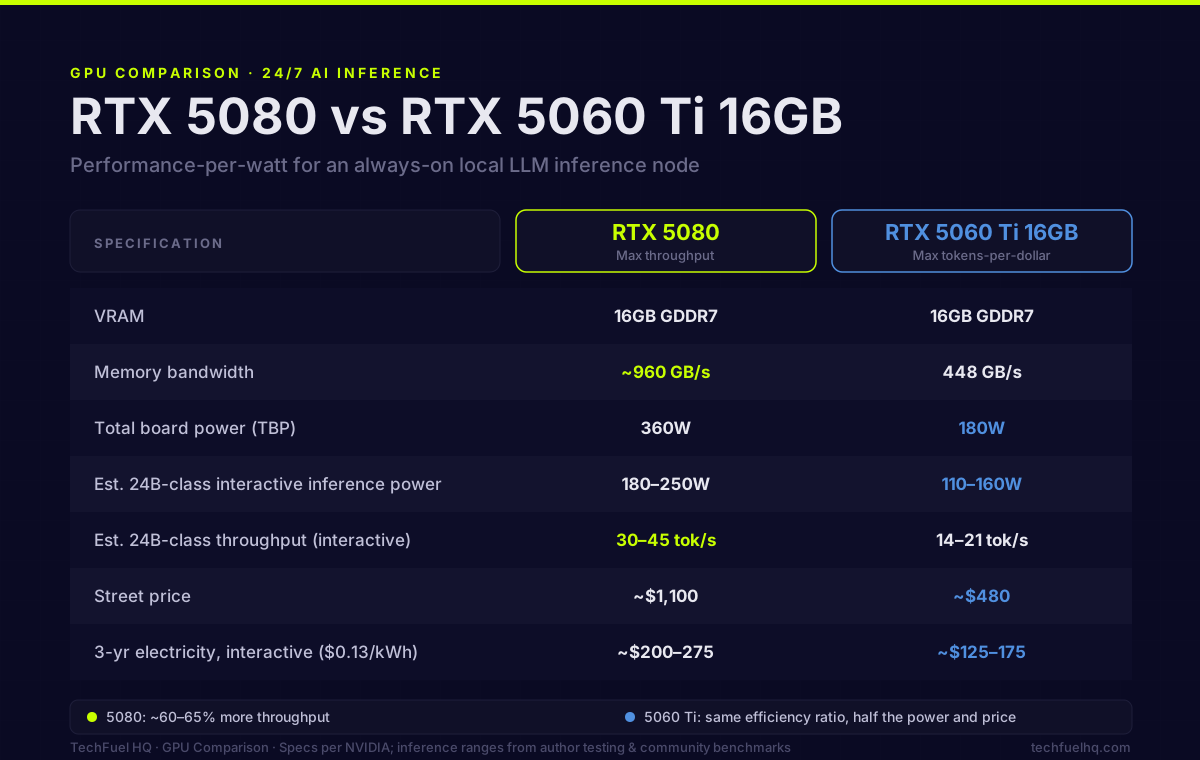
RTX 5080 vs RTX 5060 Ti 16GB for 24/7 inference
The RTX 5060 Ti 16GB at approximately $480 vs RTX 5080 at ~$1,100:
| Metric | RTX 5080 | RTX 5060 Ti 16GB |
|---|---|---|
| VRAM | 16GB GDDR7 | 16GB GDDR7 |
| Memory bandwidth | ~960 GB/s | 448 GB/s |
| TBP | 360W | 180W |
| Est. 24B-class interactive inference power | 180–250W | 110–160W |
| Est. 24B-class tok/sec (interactive) | 30–45 | 14–21 |
| Price | ~$1,100 | ~$480 |
| 3-year electricity (interactive, $0.184/kWh) | ~$285–390 | ~$175–250 |
The 5060 Ti generates roughly half the throughput (448 vs ~960 GB/s bandwidth) at a bit over half the power — tokens-per-watt lands in the same ballpark, slightly favoring the 5080. The 5080’s real advantage is absolute throughput: more tokens per second for lower latency and higher batch capacity; the 5060 Ti’s is upfront price and a lower absolute power ceiling.
Decision:
- Maximize throughput for multiple simultaneous users, batch processing, or lowest-latency responses: RTX 5080
- Maximize tokens-per-dollar over 3-year ownership for single-user interactive inference: RTX 5060 Ti 16GB
- Already own the 5080 for gaming or other GPU work: use it for inference too, the 24/7 cost is manageable
24/7 operating cost for the RTX 5080
Using the Power & Cost Calculator for a full workstation (GPU + CPU + RAM + misc):
At 6 hours/day active inference at the ~300W GPU board draw I measured, 18 hours at my measured ~60W GPU idle plus ~50W for the rest of the system:
- Annual kWh: ~(350W × 6h × 365) + (110W × 18h × 365) = 767 + 723 = 1,490 kWh/year
- At the $0.184/kWh US residential average (EIA, May 2026): $274/year
- At $0.333/kWh (California average, same EIA table): $496/year
Over 3 years at the US average: ~$822. Still well under what a heavy API user spends in a single year — and the split matters: nearly half of that bill is the idle 18 hours, which undervolting the idle state, sleeping the box, or fixing P-state residency attacks directly.
Is the RTX 5080 the right choice for a 24/7 AI node?
Yes, if:
- You’re already running it for gaming or 3D work during the day and want to use inference capacity at night
- You need to serve 2–4 simultaneous users with low latency
- You need batch throughput for document processing pipelines
- The premium over a 5060 Ti is acceptable given the hardware longevity
No (consider RTX 5060 Ti 16GB), if:
- Single-user interactive use only
- Electricity cost is a primary concern
- You’re building a dedicated inference-only node
No (consider a different approach), if:
- You need 24GB+ VRAM (step up to an RTX 4090 or RTX 5090)
- You need multi-GPU scale (consumer cards don’t support NVLink for inference, use cloud)
The ROG Astral RTX 5080 OC that I use daily — documented at the GPU dataset page and benchmarked in full in the ASUS ROG Astral RTX 5080 OC review — is the class of card this article describes. The thermal headroom from the triple-fan cooler means sustained inference loads don’t need aggressive fan curves to stay under 75°C junction.
For the undervolt settings that reduce the 5080’s 24/7 power draw: RTX 5080 Undervolt Guide. For the full workstation build: $1,000 Local AI Workstation.
Frequently asked questions
What is the RTX 5080’s VRAM bandwidth and why does it matter for AI?
How does the RTX 5080 compare to the RTX 4090 for AI inference?
What’s the idle power of the RTX 5080?
Is the RTX 5060 Ti more efficient than the RTX 5080 for AI per watt?
Can I run the RTX 5080 at a lower power limit for AI inference?
Evidence ledger
- Last updated
- Methodology
- See our methodology for research and review standards.
- Update log
- 2026-08-20 — Page updated.
- Corrections
- Spotted an error or a stale number? Email hello@techfuelhq.com. Confirmed corrections are added to the update log above.