 TechFuel HQ
By LK Wood IV · 2026-06-19 · ~13 min read · St. Louis County, MO
Self-hosted AI is the simple idea that you run the model on your own box instead of renting someone else’s. The prompt you type and the answer you get back never touch a third-party server. There is no API key, no monthly token bill, no rate limit, and the thing keeps working when your internet is down. In 2026 that is no longer a research project. It is a weekend install on hardware you may already own.
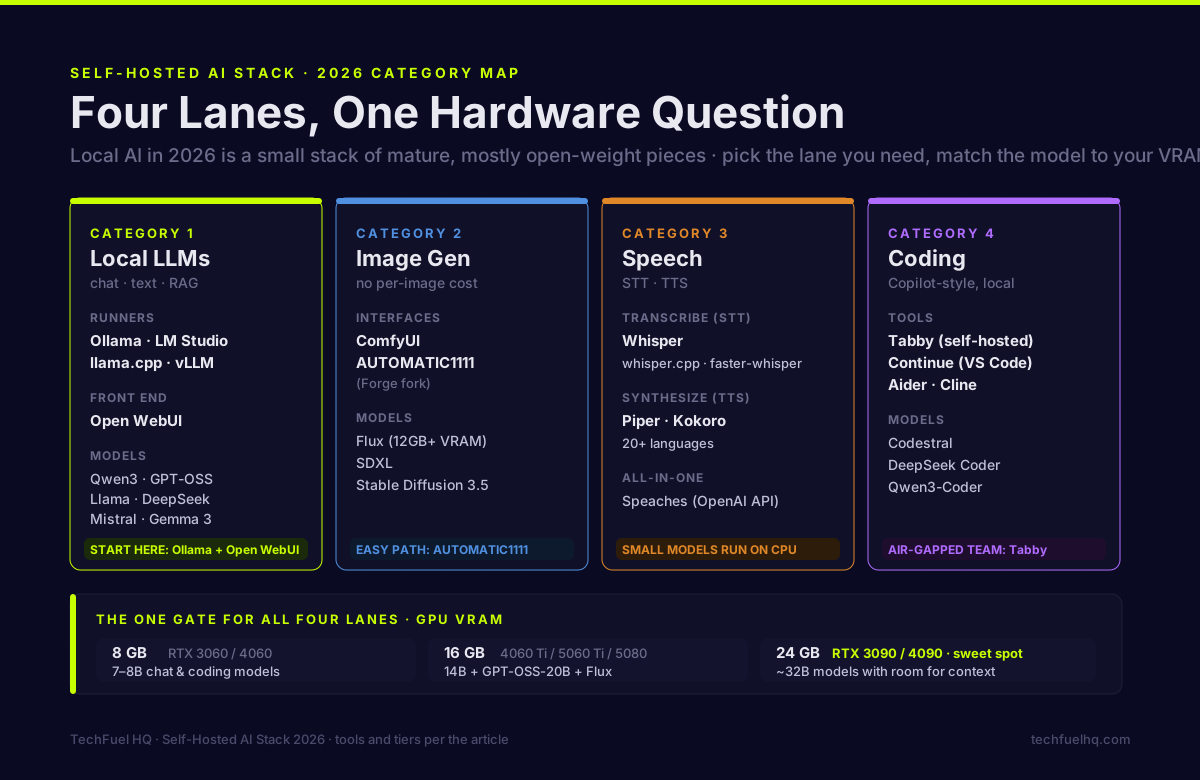
This page is the map, not the deep dive. Local AI now spans four practical categories, plus the one question that decides everything: how much GPU you need. The categories are chat and text (local LLMs), image generation, speech (transcription and synthesis), and coding assistants. I’ll lay out the real, current tools in each lane, who each is for, and where to start. Where there’s a number to get exactly right — which model fits which card, tokens per second, the cost math — I link down to the deep dives on this site rather than re-deriving it here.
Up front, because the field is loud with hype: self-hosted models are not as good as the best hosted models for the hardest tasks, and pretending otherwise wastes your weekend. The trade you are making is covered below.
Self-hosted LLM: what it is and what it takes
A self-hosted LLM is a large language model that runs on hardware you control, so your prompts never go to a third-party API. At home that means three pieces: a runner such as Ollama, an open-weight model sized to your GPU’s VRAM, and, if you want a chat window, Open WebUI in front of it. An 8GB card runs 7 to 8B models comfortably, 16GB runs 14B models, and 24GB runs models around 32B.
Whether it is worth it comes down to volume and privacy. The tradeoffs are laid out in the next section. To check what fits your card before downloading anything, use the VRAM tiers page; to install one on a specific GPU, the RTX 5060 walkthrough goes step by step.
Why self-host AI — and the tradeoffs
Three real reasons people self-host, and three real costs.
The reasons:
- Privacy. Financial questions, draft emails about coworkers, proprietary code, half-formed business ideas. None of that has to sit in a third-party log file. For sensitive workloads, local isn’t just cheaper past a break-even point, it’s the only option that keeps data off external servers.
- Cost and no rate limits. Once the hardware is paid for, inference is free at the margin. Heavy users running summarization pipelines, coding assistants, or batch jobs stop watching a token meter.
- Control. You pick the model, the quantization, the system prompt, and the version. Nothing gets deprecated out from under you, and the model runs offline.
The tradeoffs:
- Capability ceiling. As the r/LocalLLaMA and r/selfhosted crowd will tell you plainly, a single consumer GPU won’t match a frontier hosted model on the hardest reasoning and agentic tasks. An 8B–32B open-weight model is excellent for everyday work and noticeably weaker at the top end.
- Upfront hardware. The privacy and cost wins are real, but they sit behind a GPU purchase. The break-even math depends entirely on how much you actually use it.
- You are the ops team. Drivers, model downloads, container updates, and the occasional out-of-memory error are now your problem. That is a feature if you enjoy a homelab and a cost if you don’t.
The pattern most people settle into: local for volume and anything sensitive, cloud for the occasional genuinely hard problem. With that framing set, here are the four categories.
Category 1 — Local LLMs (chat, text, RAG)
This is the heart of self-hosted AI and where almost everyone starts. You run an open-weight large language model through a runner, and optionally point a chat UI at it.
The runners, by friction tolerance, all built on or alongside the same llama.cpp foundation:
- Ollama — a daemon wrapping llama.cpp with a clean CLI and model registry.
ollama pull qwen3and you’re chatting in under a minute. It exposes an OpenAI-compatible API on port11434, so existing tools point at it without code changes. This is the default starting point for one-developer use on any OS. (daily.dev) - LM Studio — a desktop GUI over llama.cpp (and MLX on Mac), with one-click model downloads and a built-in OpenAI-compatible server. Best for a GUI-first experience on Windows or Mac; measured against Ollama on the same RTX 5080, the two land within 14% of each other everywhere. (codersera)
- llama.cpp — Gerganov’s original C/C++ inference engine. The most control over quantization, batch size, and GPU layers; the most setup. Drop down to it for embedded or unusual-hardware deployments. (codersera)
- vLLM — a high-throughput serving system using PagedAttention and continuous batching. In benchmark testing it reached roughly 16–20x Ollama’s concurrent throughput, but it’s API-only and aimed at multi-user production on NVIDIA or AMD GPUs — overkill for a single-user box. (InsiderLLM)
- Open WebUI — not a runner but the front end most people pair with Ollama: a self-hosted, ChatGPT-style browser interface. The Ollama + Open WebUI combination is the single most popular local AI stack in 2026. (Google AI Overview / VirtualizationHowto)
Who it’s for: anyone who wants a private chat assistant, RAG over personal documents, or an OpenAI-API drop-in for their own scripts. Start with Ollama plus Open WebUI; reach for vLLM only when you’re serving several people at once.
On models (checked 2026-08-15): the dependable open-weight families are Alibaba’s Qwen3.8 (Apache 2.0) — the current generation, whose 27B is a compact dense model sized for a 24GB card, with the 2.4T-A95B variant aimed at data-center hardware; Qwen3.5 still covers the small sizes Qwen3.8 has not filled (0.8B/2B/4B/9B) and stays the practical pick on 8–12GB cards, with Qwen3.6 in between — OpenAI’s GPT-OSS (20B designed for 16GB cards; 120B for data-center GPUs), Meta’s Llama, DeepSeek, Mistral Small, and Google’s Gemma 3. (Hugging Face) The roster of “newest and best” shifts month to month, so the durable advice is to match the model family to your VRAM rather than chase releases — which is exactly the question the next section answers, and which our local-LLM-by-GPU-VRAM guide maps out tier by tier with real GGUF file sizes.
Category 2 — Image generation
The self-hosted image stack has consolidated around the Stable Diffusion family and Flux, driven through one of two interfaces:
- ComfyUI — a node-based interface that exposes the full generation pipeline. The pick when you need complex workflows, custom nodes, or to serve generation in a repeatable way. Steeper to learn, far more powerful. (SingularityByte)
- AUTOMATIC1111 (and the Forge fork) — a Gradio-based web UI. Install it, load a model, start generating in minutes. The beginner-friendly path. (offlinecreator)
On models, the community split in 2026 is roughly: Flux (from Black Forest Labs) for the best current photorealism if your card has 12GB+ of VRAM, and SDXL or Stable Diffusion 3.5 checkpoints — often fine-tuned versions pulled from Civitai — for stylized, illustrated, or anime output with the broadest community support. (BentoML, Awesome Agents)
Who it’s for: anyone generating images who wants no per-image cost, no content filter they didn’t choose, and full control over models and LoRAs. Image generation is VRAM-hungry — the better Flux models want 12–16GB+ — so it leans on the same hardware question as LLMs.
Category 3 — Speech (transcription and synthesis)
Two halves: speech-to-text (STT) and text-to-speech (TTS).
- Whisper (OpenAI’s open-source model, released 2022) remains the best general-purpose self-hosted transcription system three-plus years on. You run it through the original Python package, whisper.cpp (a C/C++ port from the team behind llama.cpp), or faster-whisper, which delivers transcription several times faster than the reference implementation. (Northflank)
- TTS — for synthesis, Piper and Kokoro are the common lightweight open-source choices, covering 20+ languages. Integrated servers like Speaches bundle faster-whisper for STT and Piper/Kokoro for TTS behind an OpenAI-compatible API — “like Ollama, but for audio.” (Northflank)
Who it’s for: anyone transcribing meetings, podcasts, or voice notes who doesn’t want audio leaving the machine, plus voice-assistant and dictation builders. Whisper’s smaller models run fine on CPU; the large model benefits from a GPU. If the destination for this audio stack is Home Assistant, the fully local voice guide measures the complete pipeline — Whisper, the LLM brain, Piper — component by component on real hardware.
Category 4 — Coding assistants
A self-hosted coding assistant gives you Copilot-style completion and chat with the model running on your own hardware:
- Tabby — an open-source, self-hosted assistant explicitly built as a Copilot alternative. It ships an admin dashboard and SSO, runs models locally by default (it can use Ollama as a backend), and plugs into VS Code and JetBrains. The clearest pick for a team that needs an air-gapped or fully self-hosted setup. (TabbyML on GitHub)
- Continue — a VS Code and JetBrains extension that points at your local Ollama model from a single shared config. The best-supported individual-developer option. (Second Talent)
- Aider / Cline — terminal-and-editor agentic tools that also run against a local Ollama endpoint.
On models, don’t take a listicle’s word for it — the tested coding picks by VRAM tier ran the contenders through an eight-task eval on this site’s RTX 5080; as of the August 2026 pass, gpt-oss 20B swept all eight tasks at the 16GB tier and Qwen3-Coder 30B was the quality ceiling for cards that fit it. Be realistic: self-hosted coding tools in 2026 are genuinely usable but still trail the best cloud assistants on the hardest tasks. (Second Talent reaches the same conclusion.) They shine when you can’t send code to the cloud, or when per-seat pricing gets expensive.
Who it’s for: privacy-bound or air-gapped teams (Tabby), and individual developers who want free, local completion (Continue + Ollama).
The hardware question: what GPU and VRAM you need
Every category above is gated by the same thing: GPU VRAM, because the model has to fit in the card’s memory for full-speed inference. I’m not going to re-derive the numbers here. This site already has the authoritative breakdowns, and duplicating them would just risk drift. The short version:
- 8GB (RTX 3060, 4060) — comfortable for 7–8B chat and coding models. The entry tier.
- 16GB (RTX 4060 Ti 16GB, 5060 Ti, 5080) — 14B models plus a 20B mixture-of-experts like GPT-OSS-20B, and enough for the better Flux image models.
- 24GB (RTX 3090, 4090) — the single-card sweet spot, running ~32B models with room for context.
For the full tier-by-tier map with real GGUF file sizes and the math behind them, see which local LLM fits your GPU by VRAM, and to check a specific model-and-card combination before you download anything, run it through the LLM VRAM calculator. If you’re picking hardware, the $1,000 local AI workstation build lays out a real parts list and the cloud-vs-local cost math at the 16GB tier. CPU and system RAM matter far less than the GPU. Any modern 6-core CPU with 32GB of RAM is plenty for a pure inference box.
How to start in an afternoon
You don’t need the workstation to begin. The fastest path, on a homelab box or spare PC with an NVIDIA GPU:
- Install Ollama. On Linux:
curl -fsSL https://ollama.com/install.sh | sh. It registers a service listening onlocalhost:11434. (On Windows, the LM Studio one-installer path is friendlier — the single-RTX-5060 walkthrough covers both end to end, including the Blackwell-driver gotcha that silently drops you to CPU.) - Pull a model that fits your card.
ollama pull qwen3for a general 8B (theqwen3:latesttag is 5.2GB), or a smaller model if you’re on 8GB. Note that tag has not been rebuilt in about a year — check the Ollama library for the newest Qwen generation before you settle on it. Check fit first with the VRAM calculator. - Test it.
ollama run qwen3 "Summarize the tradeoffs of self-hosting an LLM."First token in about a second on a modern GPU. - Add a UI. Run Open WebUI in Docker and point it at Ollama for a ChatGPT-style interface on your LAN. The official
n8nself-hosted AI starter kit bundles Ollama, Open WebUI, and a workflow engine in one Docker Compose file if you’d rather start from a template. (n8n on GitHub)
That’s a working private chat assistant in an afternoon. From there, the natural progression is to run it as a proper always-on service. A small hypervisor host is the clean way to do that — our Proxmox-on-a-mini-PC setup guide gets you from a USB installer to a first VM in under an hour, and once you’re comfortable hosting one service you’ll want the rest of the self-hosted toolbox: the self-hosted apps that replace SaaS covers the photo, notes, and password managers that pair naturally with a local AI box.
Where to go next
- New to all of this and unsure what fits your card? Start with which local LLM fits your GPU by VRAM.
- Ready to actually install on a specific GPU? The self-host a local LLM on an RTX 5060 tutorial is the hands-on path.
- Picking hardware? The $1,000 local AI workstation build guide has the parts list and the break-even math.
- Want the host to run it on? Set up Proxmox on a mini PC, then fill it with self-hosted apps that replace SaaS.
- Want the model to do things, not just answer? What a self-hosted AI agent is, and what I run separates the runtime you host from the model you can rent.
Self-hosted AI in 2026 isn’t one tool. It’s a small stack of mature, mostly free, mostly open-weight pieces, gated by how much GPU you’re willing to buy. Pick the category you actually need, match the model to your VRAM, and start with Ollama on a box you already own.
Working out of St. Louis County. Running a different self-hosted AI stack — a model, runner, or hardware combo worth comparing notes on? Send your config to contact@techfuelhq.com.
Sources
- Google AI Overview for “self-hosted AI” (Ollama + Open WebUI as the easiest stack; VRAM guidance; n8n): cited inline.
- daily.dev, “Running LLMs Locally in 2026: Ollama, llama.cpp, and Self-Hosted AI for Developers”: https://daily.dev/blog/running-llms-locally-ollama-llama-cpp-self-hosted-ai-developers/
- Codersera, “Ollama vs LM Studio vs vLLM vs llama.cpp vs MLX 2026”: https://codersera.com/blog/ollama-vs-lm-studio-vs-vllm-vs-llama-cpp-vs-mlx-2026/
- InsiderLLM, “llama.cpp vs Ollama vs vLLM: One User vs Many (2026)”: https://insiderllm.com/guides/llamacpp-vs-ollama-vs-vllm/
- Hugging Face, “The Best Open Source and Open-Weight LLM Models to Run Locally in 2026”: https://huggingface.co/blog/daya-shankar/open-source-llm-models-to-run-locally
- SingularityByte, “AI Image Generator Showdown 2026: Stable Diffusion, Flux, and ComfyUI”: https://singularitybyte.com/tutorials/ai-image-generator-stable-diffusion-vs-flux-vs-comfyui-2026.html
- BentoML, “The Best Open-Source Image Generation Models in 2026”: https://www.bentoml.com/blog/a-guide-to-open-source-image-generation-models
- Northflank, “Best open source speech-to-text (STT) model in 2026 (with benchmarks)”: https://northflank.com/blog/best-open-source-speech-to-text-stt-model-in-2026-benchmarks
- TabbyML, “Self-hosted AI coding assistant” (GitHub): https://github.com/TabbyML/tabby
- Second Talent, “Top 7 Open-Source AI Coding Assistants in 2026”: https://www.secondtalent.com/resources/open-source-ai-coding-assistants/
- n8n, “Self-hosted AI Starter Kit” (GitHub): https://github.com/n8n-io/self-hosted-ai-starter-kit
Frequently asked questions
What is self-hosted AI?
What hardware do I need for self-hosted AI?
Is self-hosted AI as good as ChatGPT?
What is the best self-hosted AI model in 2026?
Can I run self-hosted AI in Docker?
Is self-hosting AI cheaper than paying for a cloud API?
What is a self-hosted LLM?
Is it worth self-hosting an LLM?
Sources and corrections
- Last updated
- Methodology
- See our methodology for research and review standards.
- Update log
- 2026-09-13 — Scope retrofit for the query self hosted llm: added the H2 Self-hosted LLM: what it is and what it takes, with an extractable definition built only from facts already on this page (the runner, open-weight models, Open WebUI, and the 8GB, 16GB and 24GB VRAM tiers), two FAQ entries mirroring Google’s People Also Ask in a DataForSEO capture on 2026-09-13 (what a self-hosted LLM is, whether it is worth it), and LLMs in the title and seotitle. Eight em-dashes in seven prose sentences rewritten for the voice gate; no heading changed. No figure changed. Search Console showed 1 impression and 0 clicks for this URL in the 90 days before the change.
- 2026-08-15 — Meta-audit correction to the 2026-08-14 pass. That pass named Qwen3.5 “the current consumer-size generation” and called Qwen3.8 “data-center-scale” — both wrong, and wrong on the day they shipped. Re-derived 2026-08-15 from the vendor: the Hugging Face Qwen organization listing carries
Qwen3.8-27B(repo created 2026-08-05, nine days before that pass, 91,917 downloads) alongsideQwen3.8-2.4T-A95B, and the Qwen3.8-27B model card describes it verbatim as “a compact, deployment-friendly dense model” with “Number of Parameters: 27B”, introducing Qwen3.8 as “the most capable generation in the Qwen open-model family to date”. Qwen3.8 is therefore the current generation and is not data-center-only; Qwen3.5 remains correct only for the small sizes (0.8B/2B/4B/9B) that Qwen3.8 has not yet shipped. FAQ, body and the stack diagram corrected. - 2026-08-14 — Model-currency pass. The page named “Qwen3 / Qwen3.5” as the current dependable open-weight family “as of mid-2026” in both the FAQ and the body, and its quickstart pointed readers at
ollama pull qwen3with no indication of the tag’s age. Re-derived 2026-08-14 from two vendor distribution surfaces: the Hugging Face Qwen organization listing shows Qwen3.5 (2B/4B/9B/27B and 35B-A3B) published 2026-03-02 through 2026-04-24, Qwen3.6-27B/35B-A3B on 2026-04-24, and Qwen3.8-2.4T-A95B on 2026-08-12; Ollama’s own library/tags page for qwen3 is stamped “Updated 10 months ago” with qwen3:latest (digest 500a1f067a9f, 5.2GB, 40K context) dated one year ago. Qwen3.5 was named as the current consumer-size generation, the newer 3.6/3.8 releases acknowledged, and the quickstart given the tag’s age. (Corrected 2026-08-15 — see below: Qwen3.8 was not data-center-only even on 2026-08-14.) The 8B/5.2GB size claim itself was checked and is correct, so it was left as written.
- Corrections
- Spotted an error or a stale number? Email contact@techfuelhq.com. Confirmed corrections are added to the update log above.