 TechFuel HQ
At the same $549 launch price, AMD’s RX 9070 beats the RTX 5070 by roughly 11–15% at 1440p, with 16GB of VRAM versus 12GB and lower power draw. The RTX 5070 wins ray tracing, DLSS 4, and CUDA creator work. For pure 1440p gaming, the RX 9070 is the better value.
By LK Wood IV · Published 2026-07-20 · Updated 2026-07-20 · ~11 min read · St. Louis County, MO
Some retailer links below are Amazon affiliate links; if you buy through them TechFuel HQ may earn a small commission at no extra cost to you. As an Amazon Associate I earn from qualifying purchases. Commissions never influence which products get recommended — see our disclosure.
TL;DR · The verdict in 2026
- Raster winner: the RX 9070 is ~11–15% faster at 1440p and leads at 4K too (roughly 0–18% by game), per independent testing.
- VRAM & power: the 9070 has 16GB vs 12GB and a 220W vs 250W board rating — more headroom, better efficiency.
- Where the 5070 wins: heavy ray tracing (up to ~57% ahead in path-traced Wukong), DLSS 4 multi-frame gen, and CUDA/NVENC for AI and video.
- Buy the RX 9070 for pure 1440p value and VRAM longevity (XFX Swift RX 9070, Amazon).
- Buy the RTX 5070 for ray tracing, DLSS 4, or creator/AI work (PNY RTX 5070, Amazon).
Specs are from NVIDIA and AMD; benchmark deltas are from independent testing (GamersNexus), cited inline. Prices are a live Amazon snapshot dated 2026-07-20 and move week to week in the current GDDR shortage — check the retailer link before buying.
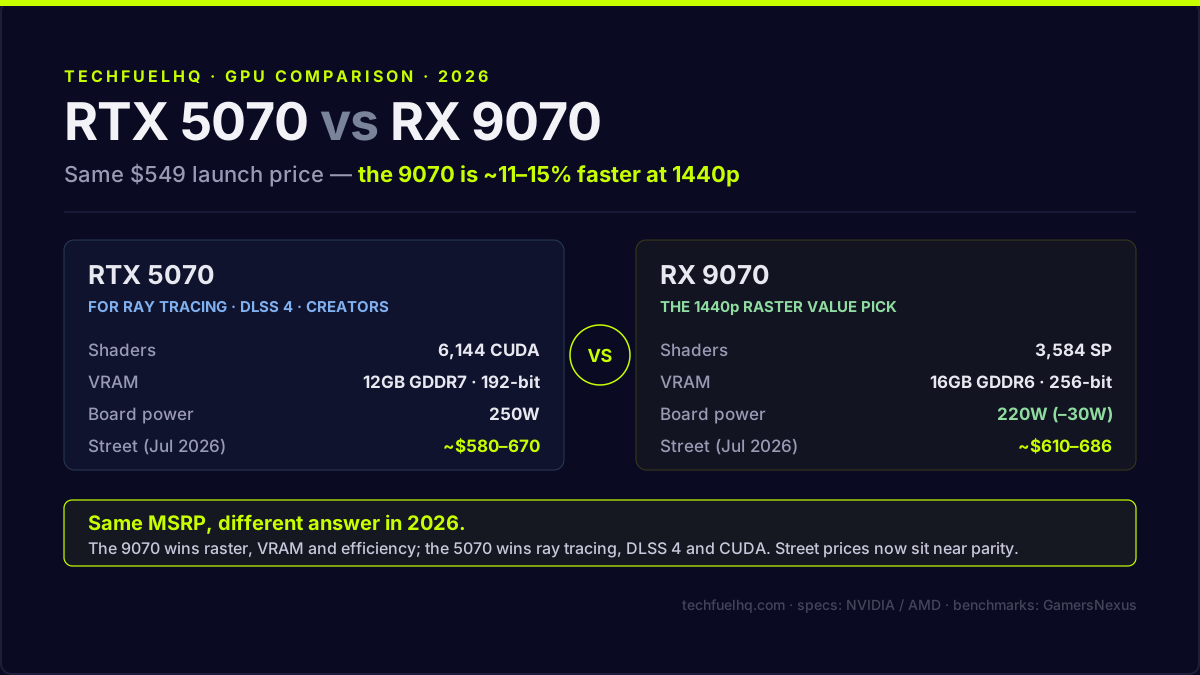
The 2026 answer isn’t the launch-day answer
Nvidia and AMD launched these two cards a day apart in March 2025 at the exact same price — $549 — and the internet spent the following year repeating one line: the RX 9070 wins because it’s faster for the same money. At MSRP, that was simply true. In mid-2026 it’s more complicated, and the honest answer now turns on what you actually do with the card, not the sticker.
Two things changed. First, neither card reliably sells at $549 anymore — a worldwide GDDR/DRAM shortage fed by AI-datacenter demand has pushed street prices up and made them volatile, and board-partner markups vary by model. Second, AMD’s drivers have matured, nudging the 9070 a little further ahead in raster while NVIDIA’s software advantages (DLSS 4, CUDA) stayed put. So the matchup is less “which is cheaper” and more “which feature set fits you.” Let’s settle it with real numbers.
The specs, honestly
Both are current-generation cards — NVIDIA’s Blackwell against AMD’s RDNA 4 — aimed squarely at 1440p. They take opposite approaches: NVIDIA leans on software and ray tracing, AMD on raw memory and rasterization.
| Spec | RTX 5070 | RX 9070 | Edge |
|---|---|---|---|
| Architecture | Blackwell (GB205) | RDNA 4 (Navi 48) | — |
| Shaders | 6,144 CUDA | 3,584 stream proc. (56 CU) | architecture-specific |
| VRAM | 12GB GDDR7 | 16GB GDDR6 | 9070 (+4GB) |
| Memory bus | 192-bit | 256-bit | 9070 |
| Board power | 250W | 220W | 9070 (–30W) |
| Upscaling | DLSS 4 (MFG) | FSR 4 | 5070 |
| MSRP | $549 | $549 | tie |
The spec sheet tells the story in miniature: the 9070 brings more memory, a wider bus, and lower power; the 5070 answers with DLSS 4 and NVIDIA’s ray tracing pedigree. Note that shader counts don’t compare across brands — a CUDA core and an RDNA stream processor do different amounts of work — so the only thing that settles the performance question is real game testing. (For a build around either 220–250W card, our PSU wattage calculator sizes the supply; both are happy on a quality 650W unit.)
How much faster is the RX 9070, really?
In GamersNexus’s launch review, the RX 9070 leads the RTX 5070 by roughly 11–15% at 1440p rasterization in the games that favor it — a couple land dead even — and the pattern holds at 4K. As always, the range is the useful part:
- Starfield (1440p): RX 9070 ~96 FPS vs RTX 5070 ~83 FPS — about a 15% lead.
- Cyberpunk 2077 (1440p): the 9070 leads by roughly 11%.
- Black Myth: Wukong (raster): the two land within error of each other — effectively tied.
- At 4K: the 9070 is generally ahead again — around +17% in Starfield and +14–15% in Cyberpunk and Dragon’s Dogma 2 — though Final Fantasy XIV flips it, with the RTX 5070 about 24% faster (a long-standing AMD weak spot).
So the honest read is “the 9070 is a bit faster than the 5070 in most rasterized games — call it low-double-digits — with the odd title going the other way.” That’s a real, repeatable edge, and it comes on top of 4GB more VRAM. For where both land against the rest of the stack, see the 2026 GPU hierarchy, or line them up head-to-head in our GPU comparison tool.
Ray tracing: where the RTX 5070 hits back
This is the one category that reliably flips the verdict. RDNA 4 narrowed AMD’s historic ray tracing deficit, and in lighter RT workloads the 9070 is genuinely competitive — GamersNexus even measured it ahead of the 5070 in Dragon’s Dogma 2 with RT enabled. But in heavy, path-traced titles the NVIDIA card still pulls away hard: in Black Myth: Wukong at 4K with ray tracing, the RTX 5070 was roughly 57% faster than the 9070.
The takeaway isn’t “AMD is bad at RT” — it’s that the gap scales with how aggressive the ray tracing is. Turn on a few reflections and shadows, and the cards are close. Turn on full path tracing in a showcase title, and the 5070 (plus DLSS 4) is in a different league. If ray tracing is central to what you play, that alone can justify the NVIDIA card.
The quiet wins: efficiency and VRAM
Two advantages don’t show up on an FPS bar but matter over the life of the card.
Efficiency. The 9070’s 220W board power isn’t just 30W lower on paper — it’s more frames per watt in practice. GamersNexus called the card “incredibly efficient,” recording it near RTX 5090-class efficiency in one 4K ray-traced test (about 0.21 FPS/W versus the RTX 5070’s 0.17 — roughly 24% better there). In a real build that means a little less heat, a little less fan noise, and more headroom on a modest PSU.
VRAM longevity. The 5070’s 12GB is fine for 1440p today, but it’s the tighter of the two, and VRAM pressure only grows. Several 2026 titles already brush past 12GB at 4K with ultra textures or ray tracing — and when a GPU runs out of memory it doesn’t slow down gracefully, it stutters and quietly drops texture quality. The 9070’s 16GB is the safer place to put your money if you game at 4K or plan to keep the card 4+ years. It’s the same reason the VRAM question dominates the tier below, in our RTX 5060 Ti vs RX 9060 XT showdown.
DLSS 4 vs FSR 4 — the software split
Upscaling is where NVIDIA keeps its clearest lead. The RTX 5070 supports DLSS 4, including multi-frame generation, which is widely implemented and generally the quality benchmark. The RX 9070 uses FSR 4, which on RDNA 4 closed much of the visual gap to DLSS but appears in fewer games. If a title you care about supports one but not the other well, let that break the tie. And if you use your GPU for more than games — AI inference, video encoding, apps built on CUDA/NVENC — that ecosystem is NVIDIA-only and a real reason to pick the 5070 despite its raster deficit.
The price picture in 2026
Here’s the part the launch-day guides get wrong today. Both cards carry a $549 MSRP, and at MSRP the math is easy: same price, AMD faster in raster, buy AMD. But in a live Amazon check on 2026-07-20, that clean gap had mostly closed:
- RTX 5070 partner cards ran roughly $580–670 (a PNY model listed at $629.99 with a $50 checkout coupon; several others $630–670).
- RX 9070 cards ran roughly $610–686 (XFX Swift ~$610–640, PowerColor Reaper ~$686).
In other words, they’re selling within a model’s margin of each other right now — sometimes the cheapest 5070 is actually a touch less than the cheapest 9070. That’s a meaningful shift from the MSRP narrative: the RX 9070’s old “faster and cheaper” pitch is now mostly just “faster in raster, similar price.” It’s still the value pick for rasterized gaming — you get more frames, more VRAM, and lower power for about the same outlay — but the decision is now feature-driven, so weigh ray tracing, DLSS, and CUDA honestly before you buy. Prices here are a dated snapshot in a volatile market; check the live retailer price before committing.
Don’t overlook the tier neighbors
Two cards sit one step away and are worth a glance before you commit. Above this pair, the RX 9070 XT and RTX 5070 Ti trade blows for a few hundred more — we cover that exact fight in RTX 5070 Ti vs RX 9070 XT, and the AMD-internal step up from this card in RX 9070 vs RX 9070 XT. And if you’re cross-shopping NVIDIA’s own stack, the RTX 5070 vs RTX 5070 Ti breakdown shows why the Ti’s real-world premium is bigger than its MSRP suggests. If your budget is firmly at this tier, though, the 5070-versus-9070 decision below is the one that matters.
So which should you buy?
- Pure 1440p gaming, best value: the RX 9070. More frames, 16GB of VRAM, lower power, similar price (XFX Swift RX 9070, Amazon).
- Ray tracing, DLSS 4, or creator/AI work: the RTX 5070. You give up a little raster to gain the RT crown, DLSS 4 frame gen, and CUDA/NVENC (PNY RTX 5070, Amazon).
- Not sure yet: run both through the GPU comparison tool and check the live price gap — at these near-equal prices, the tiebreaker is which feature set you’ll actually use.
The one mistake to avoid is buying on the year-old “9070 is faster for less” headline without checking today’s prices. In 2026 the two cards cost about the same, so pick the one whose strengths match how you play — raw 1440p frames and VRAM (AMD), or ray tracing and DLSS (NVIDIA).
Sources
- NVIDIA — GeForce RTX 5070 family specifications (RTX 5070 CUDA cores, 12GB GDDR7, 250W board power) — verified live 2026-07-20
- GamersNexus — AMD RX 9070 GPU Review & Benchmarks vs. 9070 XT, RTX 5070 (RX 9070 architecture, 1440p/4K rasterization deltas, ray tracing, and per-watt efficiency) — verified live 2026-07-20
- RX 9070 specifications (RDNA 4, 56 compute units, 16GB GDDR6 on a 256-bit bus, 220W board power) and the $549 launch MSRP it shares with the RTX 5070 reflect both companies’ March 2025 launches, cross-checked across multiple independent launch-day reports and the TechPowerUp GPU database.
- Prices: live Amazon snapshot, 2026-07-20 (retailer links above)
Frequently asked questions
What AMD GPU is equal to the RTX 5070?
Is the RX 9070 better than the RTX 5070?
Does the RTX 5070’s 12GB of VRAM limit it at 1440p?
Is the RX 9070 good for ray tracing?
RTX 5070 or RX 9070 for 1440p gaming?
Does the RX 9070 support DLSS?
How much power does the RX 9070 use compared to the RTX 5070?
Evidence ledger
- Last updated
- Methodology
- This GPU review was written and edited by Lowell K. Wood IV in St. Louis County, MO. Specs and prices verified against vendor and project documentation current on the date above. Full editorial standard: methodology.
- Update log
- 2026-08-19 — Last reviewed and updated.
- Corrections
- Spotted an error or a stale number? Email hello@techfuelhq.com. Confirmed corrections are added to the update log above.