
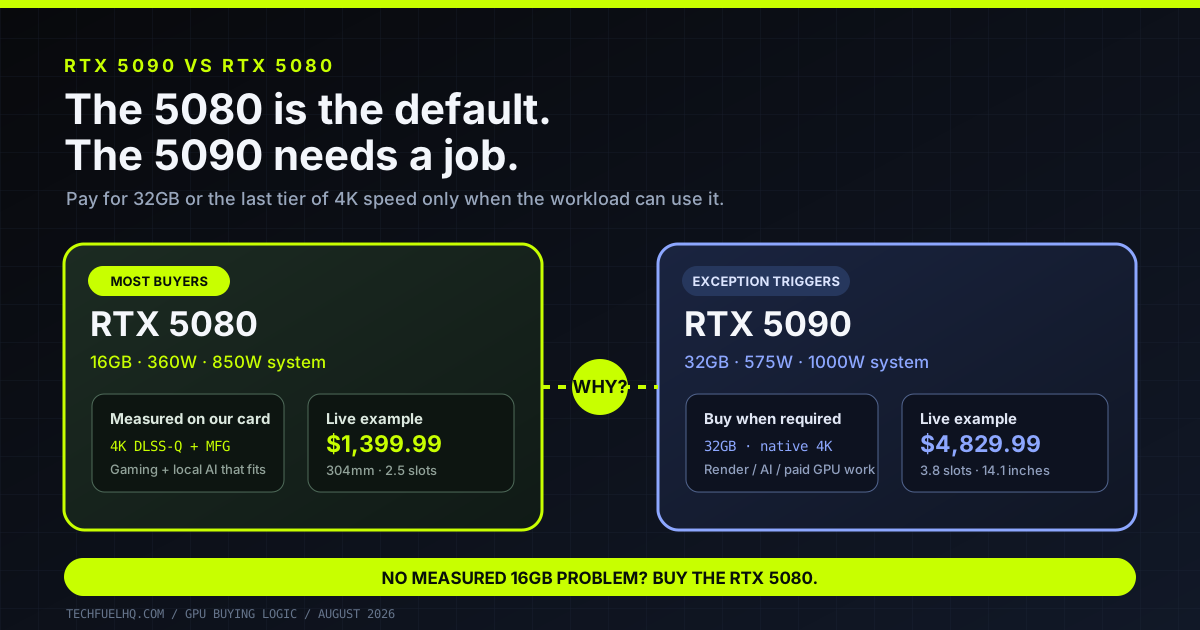
Buy the RTX 5080 for most gaming systems. Independent testing places the RTX 5090 roughly 30% to 68.9% ahead at 4K, commonly 45% to 55%, but an August 18 direct-retailer example cost 3.45 times as much. Buy the 5090 when 32GB VRAM, maximum native-4K speed, rendering, or a paid GPU workload has a real job.
Contents
By LK Wood IV · Published 2026-08-18 · 15 min read · St. Louis County, MO
The decision in one table
The RTX 5090 wins every absolute-performance question. The RTX 5080 wins the purchase question for most gamers. Whether the 5080 itself is more card than you need is the RTX 5070 Ti vs RTX 5080 question, answered the same way. The exception is a buyer whose current game, render, model, or paid workflow already reaches the 16GB boundary or whose display can turn the 5090’s extra native-4K frame rate into something visible; in that case, the larger card solves a named limit rather than serving as expensive insurance.
| Decision | RTX 5080 | RTX 5090 | Winner |
|---|---|---|---|
| 4K gaming with DLSS | Strong, measured and playable | Faster | RTX 5080 value |
| Maximum native 4K | Compromises remain in the hardest titles | Fastest tier | RTX 5090 |
| VRAM | 16GB GDDR7 | 32GB GDDR7 | RTX 5090 |
| Card power | 360W reference TGP | 575W reference TGP | RTX 5080 |
| Required system power | 850W | 1000W | RTX 5080 |
| Local AI that fits inside 16GB | Already capable | Faster/roomier, but unmeasured here | RTX 5080 value |
| Workloads that exceed 16GB | Spill or fail | 32GB headroom | RTX 5090 |
| Most gaming builds | Rational ceiling | Halo purchase | RTX 5080 |
Current direct-retailer example
Launch MSRP is useful history. It is not the number buyers face today.
| Exact card | What the listing disclosed | Live price, Aug. 18 |
|---|---|---|
| GIGABYTE WINDFORCE RTX 5080 16GB | 304mm long, 2.5 slots, 850W recommended PSU | $1,399.99 |
| ASUS ROG Astral RTX 5090 32GB | 14.1 inches, 3.8 slots, 1000W recommended PSU | $4,829.99 |
Both pages showed sold and shipped by Newegg at capture. The 5090 example cost 3.45 times as much. This is not an apples-to-apples cooler comparison: ROG Astral is a premium flagship board, while WINDFORCE is a simpler RTX 5080. It is still a real checkout comparison, and it shows why MSRP-only advice fails.
Specifications that matter
| Specification | RTX 5080 | RTX 5090 | Difference |
|---|---|---|---|
| CUDA cores | 10,752 | 21,760 | +11,008 |
| VRAM | 16GB GDDR7 | 32GB GDDR7 | 2× capacity |
| Memory interface | 256-bit | 512-bit | 2× width |
| Total graphics power | 360W | 575W | +215W |
| Required system power | 850W | 1000W | +150W |
The core count is not a frame-rate equation. Games do not scale one-for-one with CUDA cores, and CPU limits, memory behavior, ray tracing, and engine design change the gap. The capacity and power differences are literal. They shape what fits in VRAM, which supply belongs in the system, and how much heat the case must move. If the 575W is the part that worries you, the RTX 5090 undervolt guide shows what a curve and a power limit took off it in published tests.
How much faster is the RTX 5090?
Two credible suites answer this in different shapes.
GamersNexus measured the RTX 5090 30% to 68.9% ahead of the RTX 5080 at 4K, depending on the game, with results commonly in the 45% to 55% range. That wide spread is the result. A single title can land near 30%. Another can approach 70%.
TechPowerUp’s combined 3840×2160 raster chart put the RTX 5090 at 152% of the RTX 5080’s performance, a 52% suite-level lead. That aligns with the middle of the GamersNexus range while using a different game list and aggregation method.
The safe buying number is therefore not “the 5090 is always 50% faster.” It is:
- expect a large 4K lead
- expect the exact lead to move by title
- do not pay for the maximum result unless your own games resemble the workloads that produce it
At 1440p, CPU limits shrink the value of the larger GPU. If the display is 1440p, the RTX 5090 is usually an expensive way to wait on the processor.
What the RTX 5080 already does at 4K
TechFuelHQ owns and measures an ASUS ROG Astral RTX 5080 OC. The open bench dataset publishes raw values with the method and correction history under CC BY 4.0.
Measured 4K results include:
| Workload | Average FPS | 1% low |
|---|---|---|
| Cyberpunk 2077 Ultra raster | 58 | 49 |
| Cyberpunk RT Ultra, DLSS Quality | 50 | 41 |
| Cyberpunk Path Tracing, native | 19 | 15 |
| Alan Wake 2 RT, DLSS Quality | 49 | 38 |
| Black Myth Wukong Cinematic | 34 | 27 |
The card needs help in the hardest path-traced workload. That is where DLSS 4 changes the buying decision. On the same system, Cyberpunk 4K path tracing measured:
| Mode | Output FPS | PC latency |
|---|---|---|
| Native path tracing | 19 | 95ms |
| DLSS Quality, no frame generation | 40 | 45ms |
| DLSS Quality + MFG 2× | 90 | 55ms |
| DLSS Quality + MFG 4× | 135 | 62ms |
If those techniques are acceptable, the RTX 5080 is already a serious 4K card. The RTX 5090 buys more native headroom and a higher starting frame rate. It does not make the RTX 5080 incapable.
The 16GB versus 32GB decision
For gaming, 16GB is the practical high-end capacity today. The first-party 4K runs above fit and complete on the RTX 5080. Buying 32GB solely because a future game might need it is weak evidence.
For work, capacity can become binary. A render scene, local model, image batch, or timeline either fits in VRAM or it does not. Once the workload crosses 16GB, the RTX 5090’s performance advantage is no longer just frames per second. It can keep work on the GPU that the 5080 must spill, reduce, or refuse.
Name the workload before paying:
- What is the current peak VRAM allocation?
- Does lowering batch size destroy throughput?
- Does CPU/RAM offload create an unacceptable delay?
- Does the extra GPU memory replace a second card, cloud bill, or work interruption?
If there is no measured 16GB problem, the 32GB answer is insurance at flagship pricing.
Local AI: use measured data, not parameter-count folklore
The RTX 5080 local LLM throughput dataset is measured on the same retail card and mirrored on Kaggle and Hugging Face. It shows what 16GB can already do:
- gpt-oss:20b MXFP4: 187–190 decode tokens/second
- resident VRAM: roughly 13.7–14.0 GiB
- Qwen 2.5 14B Q4_K_M: 94–97 tok/s
- Qwen 2.5 7B Q4_K_M: 177–180 tok/s
This site has no first-party RTX 5090 AI result, so I will not invent a speed multiplier. The grounded claim is capacity: 32GB gives room for larger fully resident models, longer contexts, image work, plus larger batches. The grounded counterclaim is equally important: 16GB is already enough for fast interactive use on several useful models.
Buy the 5090 for AI when a workload you run now exceeds the 5080’s capacity. Buy the 5080 when your actual models fit.
Power, case, and the rest of the system
The RTX 5090 adds 215W of reference board power. That changes more than the electric bill.
NVIDIA specifies 850W required system power for the RTX 5080 and 1000W for the RTX 5090. TechFuelHQ’s full RTX 50-series PSU guide treats 1200W as the practical high-end 5090 target once a powerful processor and factory-overclocked board enter the build.
Physical size follows the same pattern in the live examples:
- GIGABYTE WINDFORCE RTX 5080: 304mm, 2.5 slots
- ASUS ROG Astral RTX 5090: 14.1 inches, 3.8 slots
That can determine case choice, front-radiator clearance, lower-slot access, GPU support, and cable bend radius. The GPU price is only the first system cost.
Price-to-performance without fake precision
Using TechPowerUp’s 52% combined 4K raster lead and the two live listings above:
- performance multiplier: about 1.52×
- price multiplier: about 3.45×
That does not produce a universal “value score.” The cards are different AIB tiers, and the RTX 5090 also buys double the VRAM. It does show the shape of the purchase: live retail asks for far more money than the gaming-performance increase alone returns.
The RTX 5090 can still be the cheaper business tool when its 32GB capacity replaces cloud GPU time, cuts a render queue, or prevents an out-of-memory failure. Put a number on that benefit before paying: if the larger card saves four billable hours each week, avoids a recurring cloud instance, and keeps a current scene fully resident, the purchase has three measurable payback paths; if it only raises a benchmark score, gaming receives none of that accounting benefit.
Buy the RTX 5080 if
- the system is primarily for gaming
- DLSS Quality and frame generation are acceptable at 4K
- current workloads fit inside 16GB
- you want an 850W-class build with easier case fit
- the 5090 price premium would delay the monitor, storage, or next upgrade
Buy the RTX 5090 if
- maximum native or lightly upscaled 4K performance is the requirement
- 32GB solves a measured memory-capacity problem
- rendering, AI, or creation time has direct financial value
- the larger PSU, case, cooling, and card price are already budgeted
- money-no-object performance is itself the goal
The first list describes most buyers. The second describes a smaller group with better reasons, and the difference should survive a simple counterfactual: if the paid workload, 32GB allocation, or native-4K display disappeared tomorrow, would the rest of the purchase still justify a card that costs several thousand dollars more and forces a larger power and cooling envelope?
Complete system or card?
If you want the GPU inside a ready-to-run tower, compare the best RTX 5080 prebuilts and best RTX 5090 prebuilts. Those guides rank power delivery and memory layout, then check storage, seller, and warranty details that disappear when a listing talks only about the GPU. Before you pay the step up in a tower, note what the system-level premium actually buys: two otherwise identical CLX machines differ by $2,400 on the card alone, with the same CPU, memory and storage on both.
For the card alone, confirm the exact item and dimensions, then verify the recommended supply, seller, warranty, and return terms. A GPU family name is not the product in your cart.
Frequently asked questions
How much faster is the RTX 5090 than the RTX 5080?
Is the RTX 5090 worth the price over the RTX 5080?
Is the RTX 5080 enough for 4K gaming?
Should I buy an RTX 5090 or RTX 5080 for local AI?
What power supply do the RTX 5090 and RTX 5080 need?
Is 16GB VRAM enough, or should I buy 32GB?
Sources and corrections
- Last updated
- Methodology
- See our methodology for research and review standards. It draws on 8 cited sources, listed below, each checked against the original page on 2026-08-18. This comparison separates three evidence classes: NVIDIA official specifications, independent cross-GPU benchmark suites, and TechFuelHQ first-party RTX 5080 measurements. I have not tested an RTX 5090. The live price example compares two exact direct Newegg AIB listings and is clearly labeled as a current-retail example rather than a reference-card price ratio.
- Sources
- NVIDIA GeForce RTX 5090 official specifications accessed 2026-08-18
- NVIDIA GeForce RTX 5080 official specifications accessed 2026-08-18
- GamersNexus RTX 5080 review and RTX 5090 comparison accessed 2026-08-18
- TechPowerUp RTX 5080 relative performance accessed 2026-08-18
- TechFuelHQ ROG Astral RTX 5080 open bench dataset accessed 2026-08-18
- TechFuelHQ RTX 5080 local LLM throughput dataset accessed 2026-08-18
- GIGABYTE WINDFORCE RTX 5080 Newegg listing accessed 2026-08-18
- ASUS ROG Astral RTX 5090 Newegg listing accessed 2026-08-18
- Update log
- 2026-10-01 — Added a link to the RTX 5070 Ti vs RTX 5080 comparison beside the purchase verdict. No figure on this page changed.
- 2026-08-18 — Published from official NVIDIA specifications, independent 4K benchmark suites, dated retailer listings, and TechFuelHQ’s open RTX 5080 gaming and LLM datasets.
- Corrections
- Spotted an error or a stale number? Email contact@techfuelhq.com. Confirmed corrections are recorded here with the date and change.