 TechFuel HQ
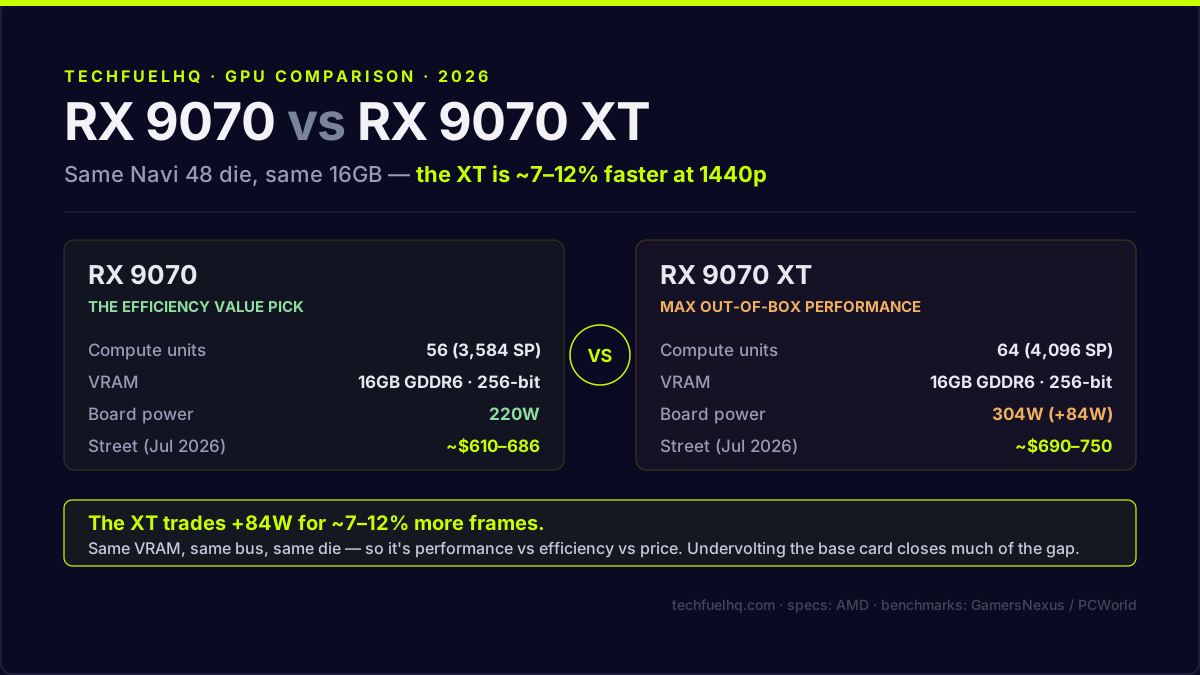
The RX 9070 XT is about 7–12% faster than the RX 9070 at 1440p and pulls further ahead in ray tracing, but it draws 84W more (304W vs 220W). Both share 16GB of GDDR6 and the same die. Buy the XT for max out-of-box frames; buy the 9070 for efficiency and value.
By LK Wood IV · Published 2026-07-20 · Updated 2026-07-20 · ~10 min read · St. Louis County, MO
Some retailer links below are Amazon affiliate links; if you buy through them TechFuel HQ may earn a small commission at no extra cost to you. As an Amazon Associate I earn from qualifying purchases. Commissions never influence which products get recommended — see our disclosure.
TL;DR · The verdict in 2026
- Performance: the XT is ~7–12% faster at 1440p (~9% at 4K, up to ~16% in ray tracing) — real, but smaller than the name implies.
- The catch is power: the XT draws 84W more (304W vs 220W board power) for that ~10%, so it runs hotter and wants a bigger PSU.
- VRAM is a tie: both are 16GB GDDR6 on a 256-bit bus, same Navi 48 die — neither ages better on memory.
- Buy the RX 9070 XT for max out-of-box frames or 4K (PowerColor Reaper 9070 XT, Amazon).
- Buy the RX 9070 for efficiency, a quieter build, and value (XFX Swift RX 9070, Amazon).
Specs are from AMD; benchmark deltas are from independent testing (GamersNexus, PCWorld), cited inline. Prices are a live Amazon snapshot dated 2026-07-20 and move week to week in the current GDDR shortage — check the retailer link before buying.
The 9070 family’s confusing middle
AMD’s RDNA 4 line put three cards within a hair of each other — the RX 9070, the RX 9070 XT, and the 12GB 9070 GRE — and the two that matter most for a mainstream build are the first two. They look nearly identical on a spec sheet, share the same Navi 48 GPU and the same 16GB of memory, and sell within about a hundred dollars of each other. So the real question isn’t “which is better” — the XT is, plainly — it’s “is the XT’s extra performance worth its extra power and price for you?” That’s a narrower, more answerable question, and the numbers settle it. (If you’re cross-shopping the plain 9070 against NVIDIA instead, we cover that in RTX 5070 vs RX 9070.)
The specs, honestly
Both cards are cut from the same silicon. The XT simply has more of it switched on, running faster:
| Spec | RX 9070 | RX 9070 XT | Edge |
|---|---|---|---|
| Architecture | RDNA 4 (Navi 48) | RDNA 4 (Navi 48) | same die |
| Compute units | 56 | 64 | XT (+14%) |
| Stream processors | 3,584 | 4,096 | XT (+512) |
| VRAM | 16GB GDDR6 | 16GB GDDR6 | tie |
| Memory bus | 256-bit | 256-bit | tie |
| Board power | 220W | 304W | 9070 (–84W) |
| MSRP | $549 | $599 | +$50 |
The XT enables about 14% more compute units and stream processors and clocks higher out of the box — on paper a decent jump. But paper isn’t frames, and the same die plus identical memory means the two behave far more alike than, say, a 5070 versus a 5070 Ti (which differ in VRAM too). Line them up against the rest of the stack in the 2026 GPU hierarchy or the GPU comparison tool.
How much faster is the XT, really?
Independent testing lands in a tight, consistent band. GamersNexus measured the 9070 XT “roughly 9–12% better than the 9070 in most of the games we tested” at 1440p — for example Dragon’s Dogma 2 at 116 FPS (XT) vs 106 FPS (9070), a 9.3% gap. PCWorld put the average lower still, at about 7% across their suite. So the honest figure is roughly 7–12% at 1440p — GamersNexus saw a similar ~9% at 4K (Dragon’s Dogma 2 at 70 vs 64 FPS) and a wider gap in ray tracing, up to about 16%, where the XT’s extra compute stretches its legs.
That’s a real, repeatable edge — but it’s the kind of gap you measure with a frame counter, not one you feel across a session. Both cards clear high-refresh 1440p comfortably and handle entry 4K. Drivers have also matured since these March-2025 launch reviews, nudging RDNA 4 up a little across the board, but the relative order hasn’t changed.
The catch: 84 watts for ~10%
Here’s the trade the spec sheet makes plain. That ~7–12% comes at a 304W board power rating versus 220W — an 84W jump — and independent testing measured real draw around 310W (XT) versus 224W (9070). GamersNexus called the plain 9070 “incredibly efficient” and described it as sitting in “the so-called sweet spot of power and performance,” delivering more frames per watt than its bigger sibling.
In a real build that gap matters more than a single-digit FPS delta. The 9070 runs cooler and quieter, fits comfortably on a quality 550–650W supply, and puts less heat into a small case; the XT wants stronger cooling, better airflow, and headroom on the PSU. Size either one with our PSU wattage calculator before you buy — the XT’s draw is a real line item, not a rounding error.
The tiebreaker that isn’t: VRAM
One of the biggest levers in most GPU comparisons is simply off the table here. Both cards carry 16GB of GDDR6 on a 256-bit bus — identical memory, identical 640 GB/s of bandwidth. Neither will run out of VRAM before the other, and neither ages better on that axis. That’s the opposite of a cross-brand fight like RTX 5070 vs RX 9070, where the 12GB-vs-16GB question does real work. Between these two Radeons, forget VRAM and decide on performance, power, and price alone.
Undervolt and the value case
RDNA 4 responds unusually well to tuning, and it cuts both ways in this matchup. The RX 9070 XT is a popular undervolt target — dropping voltage trims its considerable power draw and temperatures with little performance loss (and, because the card is power-limited, often adds a few frames), taking the sting out of that 304W rating. But the same flexibility means the base RX 9070 overclocks well, so a tuned 9070 can close much of the gap to a stock XT. That’s why the community verdict — echoed in the buying advice that shows up right in Google’s own summary for this matchup — is that a cheaper 9070 you push a little is often the smarter money than paying up for the XT and leaving it stock.
The price picture in 2026
At MSRP this was an easy call: $549 vs $599 is a $50 (9%) step for ~7–12% more performance, so the XT was a textbook upsell. But like the rest of the market in 2026, neither sells at MSRP. In a live Amazon check on 2026-07-20:
- RX 9070 cards ran roughly $610–686 (an XFX Swift near $620, a PowerColor Reaper toward $686).
- RX 9070 XT cards ran roughly $690–750 for mainstream models (premium designs past $800).
So the street premium has widened to about $80–100, not $50 — enough that the 9070’s efficiency and lower price tilt the value math back toward it. The XT is still the right buy if you want the most frames out of the box or you game at 4K; the 9070 is the pick if the premium is real to you or efficiency matters. A GDDR shortage keeps these prices volatile, so treat the snapshot as a method and check the live price before you commit.
So which should you buy?
- Want the most performance out of the box, or game at 4K: the RX 9070 XT. You pay ~$80–100 more and 84W more for ~7–12% higher frames, more in ray tracing (PowerColor Reaper RX 9070 XT, Amazon).
- Value efficiency, a quiet build, or a smaller PSU: the RX 9070. Same 16GB, ~90% of the frames, 84W less heat, and it undervolts-or-overclocks to taste (XFX Swift RX 9070, Amazon).
- Cross-shopping NVIDIA: see how the tier lines up in RTX 5070 Ti vs RX 9070 XT and RTX 5070 vs RX 9070.
The one thing not to do is buy the XT purely because it has the “XT” on the box. It’s the faster card, but the gap is single-digits-to-low-double-digits, the power cost is real, and at 2026 street prices the plain 9070 is often the smarter buy. Decide on the price gap in front of you, not the badge.
Sources
- GamersNexus — Incredibly Efficient: AMD RX 9070 GPU Review & Benchmarks vs. 9070 XT, RTX 5070 (1440p/4K raster deltas, ray tracing, power draw and efficiency) — verified live 2026-07-20
- PCWorld — AMD Radeon RX 9070 and 9070 XT review (the ~7% XT-over-9070 average) — verified live 2026-07-20
- Core specs — 56 vs 64 compute units, 16GB GDDR6 on a 256-bit bus, and the ~224W vs ~310W measured power draw — are stated in the cited GamersNexus review; the $549 vs $599 MSRP is confirmed by the cited PCWorld review. Stream-processor counts (3,584 vs 4,096) follow from the compute-unit counts, and the 220W vs 304W board-power ratings are AMD’s published figures, corroborated by those measured draws.
- Prices: live Amazon snapshot, 2026-07-20 (retailer links above)
Frequently asked questions
Is there a big difference between the RX 9070 and RX 9070 XT?
Is the RX 9070 XT worth it over the RX 9070?
Is the RX 9070 XT considered high end?
How much more power does the RX 9070 XT use than the RX 9070?
Can you undervolt the RX 9070 XT to run cooler?
Do the RX 9070 and RX 9070 XT have the same VRAM?
Evidence ledger
- Last updated
- Methodology
- This GPU review was written and edited by Lowell K. Wood IV in St. Louis County, MO. Specs and prices verified against vendor and project documentation current on the date above. Full editorial standard: methodology.
- Update log
- 2026-08-19 — Last reviewed and updated.
- Corrections
- Spotted an error or a stale number? Email hello@techfuelhq.com. Confirmed corrections are added to the update log above.