 TechFuel HQ
By LK Wood IV · Published 2026-07-20 · Updated 2026-08-24 · ~13 min read · St. Louis County, MO
Some retailer links below are Amazon affiliate links; if you buy through them TechFuel HQ may earn a small commission at no extra cost to you. As an Amazon Associate I earn from qualifying purchases. Commissions never influence which products get recommended — see our disclosure.
TL;DR · Which Seagate drive for your NAS
- Light-duty home NAS (2–4 bays): standard IronWolf — 180TB/year is plenty, and it's one of the cheapest new NAS-rated CMR drives. Tops out at 16TB.
- Heavy 24-7 use or a big array: IronWolf Pro — 550TB/year workload, 5-year warranty, 3 years of bundled Rescue Data Recovery, up to 32TB.
- Best price-per-TB (the homelab move): a recertified enterprise Exos. A recertified 16TB Exos was $30.62/TB in our July 20 pull vs ~$43/TB for a new NAS drive — but check it's SATA, not SAS.
- The reality: IronWolf Pro and Exos are the same base drive with different firmware, grade, and warranty. For most home NAS builds, buy on price and warranty channel, not the badge.
- The one rule: whatever tier you pick, run redundancy and keep a real 3-2-1 backup. RAID is not a backup.
Spec numbers are from Seagate's current data sheets. Prices are a live Amazon snapshot dated 2026-07-20 and move week to week — check the retailer link before buying.
The short version
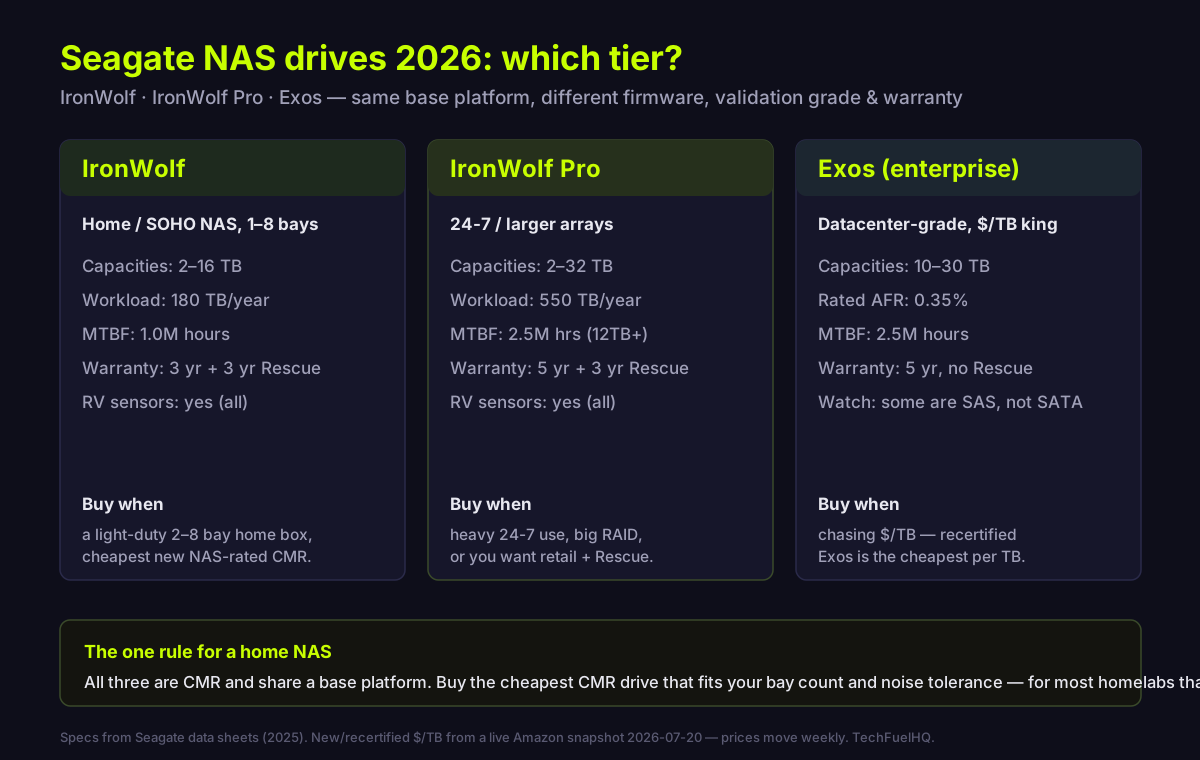
Seagate sells three families that all end up in NAS boxes, and the naming makes them sound like a simple good–better–best ladder. They mostly aren’t. Here is the 30-second version:
- IronWolf is the home/SOHO NAS drive: CMR, 1-to-8-bay rated, capacities from 2TB to 16TB, a 180TB/year workload rating, and a 3-year warranty.
- IronWolf Pro is the heavier-duty NAS drive: same CMR, but a 550TB/year workload, 2.5-million-hour MTBF on the big models, a 5-year warranty, and capacities all the way to 32TB.
- Exos is the enterprise/datacenter drive that homelabbers buy for its price per terabyte — the same 7200-RPM CMR mechanics, rated to a 0.35% annual failure rate, but sold through channels where recertified units routinely undercut new NAS drives on $/TB.
The twist that the ranking forum threads and the AI Overview never quite pin down: IronWolf Pro and Exos are, on the spec sheet, essentially the same drive — and the current IronWolf Pro has quietly closed the reliability-rating gap that used to separate them. So the real decision is less “which is the better drive” and more “which capacity, at which price, through which warranty channel.” Let’s ground all of that in the actual data sheets and a dated price pull. For the box these drives go into, see our budget NAS build guide; for the cross-brand best-picks by use case (WD Red Plus, Toshiba N300, and where Seagate fits), see the best NAS hard drives guide. This page is specifically about choosing within the Seagate lineup.
The spec table — current Seagate data sheets
Every number below is from Seagate’s current data sheets (linked in Sources), not a reseller listing. Where Seagate lists a value only for certain capacities, that’s noted.
| Spec | IronWolf | IronWolf Pro | Exos (X-series) |
|---|---|---|---|
| Role | Home / SOHO NAS | 24-7 NAS, large arrays | Enterprise / datacenter |
| Capacities | 2–16TB | 2–32TB | ~10–30TB |
| Recording | CMR | CMR | CMR |
| Spindle | 7200 RPM (8TB+) | 7200 RPM | 7200 RPM |
| Workload rating | 180 TB/yr | 550 TB/yr | 24-7 rated* |
| MTBF | 1.0M hr | 2.5M hr (12TB+) | 2.5M hr |
| Rated AFR | not published | not published | 0.35% |
| Warranty | 3 yr | 5 yr | 5 yr |
| Rescue Data Recovery | 3 yr included | 3 yr included | none |
| RV sensors | yes (all current) | yes (all) | yes |
| Bays | 1–8 | unlimited | enterprise (unlimited) |
| Interface | SATA | SATA | SATA or SAS |
*The Exos marketing data sheets cited here list a 0.35% annual failure rate and 24-7 operation (8,760 power-on hours/year) rather than a TB/year workload number; Exos is built for the same continuous-duty class as IronWolf Pro.
Three things worth pulling out of that table:
- The standard IronWolf now reaches 16TB. Seagate’s September 2025 IronWolf data sheet lists 2, 4, 6, 8, 10, 12, and 16TB; the old 14TB and 18TB SKUs were dropped. If you see an 18TB “IronWolf” (non-Pro), it’s old stock, not the current line.
- RV sensors are on every current model, even standard IronWolf. Older IronWolf data sheets marked the smallest capacities as lacking rotational-vibration sensors; the current sheet lists RV sensors as “yes” across the whole line. That’s a real improvement for anyone putting standard IronWolf into a multi-bay enclosure.
- The workload gap is the clearest real difference. 180 vs 550 TB/year is the number that actually separates IronWolf from Pro/Exos. For a home NAS storing media and backups you will rarely approach even 180TB/year of writes; for a busy multi-user or surveillance array, the 550 rating (and the 5-year warranty that comes with it) is the honest reason to step up.
Are Exos and IronWolf Pro the same drive?
This is the single most-argued question in every Seagate NAS thread, and the forum answer — “they’re the same drive, Exos just has different firmware” — turns out to be mostly right, but nobody grounds it. Here’s the spec-sheet evidence.
Line up Seagate’s own data sheets for a matched 16TB Exos X16 and IronWolf Pro and the mechanical fingerprint is identical, down to the gram:
- Weight: 670 g on both.
- Dimensions: 26.11 × 101.85 × 146.99 mm on both.
- Spindle / cache / latency: 7200 RPM, 256MB cache, 4.16 ms average latency — identical.
- Read-error rate: 1 per 10^15 bits on both.
- Vibration tolerance: 12.5 rad/s² on both.
That is not what two different drives look like. It’s what one base platform looks like, wearing two firmware loads and two labels. Seagate has never published a component-level bill of materials, so this is strong circumstantial evidence rather than a teardown — but a weight-to-the-gram, dimension-for-dimension, latency-for-latency match across two separate spec sheets is about as close as public documentation gets.
What actually differs is the grade and the software:
- Validation / reliability rating. Exos is rated to a 0.35% AFR and 2.5M-hour MTBF; the older IronWolf Pro that shared the 16TB platform was rated 0.73% AFR / 1.2M-hour MTBF on its 2019 data sheet (linked in Sources). That’s an enterprise validation and binning difference, not a different mechanism.
- Firmware and features. Exos adds enterprise-oriented features (PowerBalance, SuperParity, security/SED options, and a SAS variant). IronWolf Pro adds the consumer-friendly stack: IronWolf Health Management and 3 years of bundled Rescue Data Recovery.
Here’s the part the old threads miss: on the current data sheets, IronWolf Pro has caught up. Today’s IronWolf Pro (the “NT” models) is rated to the same 550 TB/year workload and the same 2.5-million-hour MTBF as Exos on the helium 12TB-and-up capacities. The historical “Exos is the more durable tier” gap is now largely a legacy-spec artifact — the current Pro is specced right alongside Exos, and simply adds Rescue and a retail warranty channel on top.
So the accurate way to say it: IronWolf Pro and Exos are the same base drive at similar grade; you’re really choosing a feature set and a purchase channel. Retail IronWolf Pro gets you Rescue, easy RMA, and a shelf full of new units. Exos gets you the enterprise feature options and — crucially — the recertified market, which is where the price story lives.
Two myths, spec-checked
Because Exos is an “enterprise” drive, two beliefs follow it around. Both fail against Seagate’s own numbers.
“Exos is louder.” At a matched generation, the Exos X-series and IronWolf Pro publish the same typical acoustics: about 2.8 bels idle and 3.2 bels seek. There is a genuine wrinkle worth flagging that no competitor mentions: Seagate reports acoustics inconsistently across its own lines — the consumer IronWolf sheet uses sound-pressure dBA, while the Pro and Exos sheets use sound-power bels — so a clean cross-line “X dBA vs Y dBA” comparison doesn’t actually exist in the source data. The honest read: all three are 7200-RPM drives, all are audible under seek, none is engineered to be quiet, and Exos’s louder reputation is mostly spin-up chatter plus the fact that people run bare enterprise drives in undampened cases. The homelab community consensus (r/DataHoarder, r/homelab) lands in the same place: recertified Exos “aren’t louder than IronWolf once spun up,” they’re just loud at boot — so isolate the NAS in a closet or a dampened case rather than choosing your drive by noise.
“Exos draws more power.” Also not supported at a matched size. At 16TB, idle power is identical (5.0W on both) the Exos X16 and IronWolf Pro. Their operating figures aren’t directly comparable because Seagate publishes “max operating” for Exos and “average operating” for IronWolf Pro — different definitions, not a real gap. The newer, denser Exos X24 does idle higher (about 6.3W) than the 2019-era 16TB drives, but that’s a generational change (bigger cache, denser platters), not an Exos-versus-IronWolf penalty.
Which one for your NAS
Sort by what your NAS actually is:
- A quiet 2–4 bay home NAS for media and backups. Standard IronWolf is enough. You will not touch the 180TB/year ceiling, RV sensors are now standard across the line, and it’s among the cheapest new NAS-rated CMR drives. If a recertified Exos of the same size is meaningfully cheaper per TB and you run redundancy, take the Exos instead (see pricing below).
- A busy always-on array, many users, virtualization, or 6+ bays. Step to IronWolf Pro (or Exos). The 550TB/year workload and 5-year warranty are the point, and the bundled 3-year Rescue is a genuine safety net. Between Pro and Exos here, it’s price and warranty channel: new-with-Rescue (Pro) versus cheapest-per-TB (recertified Exos).
- Chasing maximum capacity per dollar and you run ZFS/parity + backups. Recertified enterprise Exos, full stop — it’s the homelab budget path and has been for years. Just confirm SATA vs SAS and treat the warranty as the seller’s, not Seagate’s.
- Surveillance/NVR duty specifically. Neither of these three — that’s what SkyHawk is for — but if you’re mixing, an IronWolf/Pro handles light NVR loads fine.
Whatever you pick, size the array after redundancy, not before: a four-bay box of 16TB drives is not 64TB usable once you account for a parity or mirror drive. Run the real numbers in the NAS & RAID storage calculator before you buy.
The $/TB reality — live Amazon snapshot, 2026-07-20
Here’s where the decision usually gets made. Below is a live US Amazon price pull captured 2026-07-20; $/TB uses the drive’s marketed (decimal) capacity. Prices move week to week in the 2026 drive market — treat this as a method, not a promise, and check the retailer link before buying.
| Drive (model) | Condition | Capacity | Price | $/TB | Link |
|---|---|---|---|---|---|
| Seagate IronWolf (ST12000VN0008) | New | 12TB | $429.99 | $35.83 | Amazon |
| Seagate IronWolf (ST16000VN001) | New | 16TB | $689.97 | $43.12 | Amazon |
| Seagate IronWolf Pro (ST12000NT001) | New | 12TB | $459.99 | $38.33 | Amazon |
| Seagate IronWolf Pro (ST16000NT001) | New | 16TB | $698.00 | $43.63 | Amazon |
| Seagate IronWolf Pro (ST20000NT001) | New | 20TB | $669.99 | $33.50 | Amazon |
| Seagate Exos X18 (ST16000NM000J) | New | 16TB | $685.00 | $42.81 | Amazon |
| Seagate Exos X16 (ST16000NM001G) | Recertified | 16TB | $489.99 | $30.62 | Amazon |
| Seagate IronWolf Pro (ST16000NE000) | Recertified | 16TB | $599.00 | $37.44 | Amazon |
| Seagate Exos (ST26000NM000C) | Recertified | 26TB | $669.00 | $25.73 | Amazon |
Three takeaways jump out:
- Recertified enterprise Exos is the $/TB champion by a wide margin. A recertified 16TB Exos at $30.62/TB undercut a new IronWolf Pro 16TB ($43.63/TB) by about 30%, and a recertified 26TB Exos fell to $25.73/TB — the cheapest per terabyte in the table. This is exactly the play the homelab community leans on during the 2026 drive crunch.
- Within the new drives, IronWolf and IronWolf Pro are nearly the same price at a given capacity (16TB: $689.97 vs $698.00). So if you’re buying new at 16TB, the Pro’s extra workload rating, 5-year warranty, and Rescue cost only a few dollars — an easy upgrade.
- Bigger isn’t reliably cheaper per TB, but sometimes it is. The new IronWolf Pro 20TB ($33.50/TB) was cheaper per terabyte than the 16TB ($43.63/TB) in this pull — a shortage-pricing quirk. Always run the per-TB number for your target capacity on the day you buy.
The SATA-vs-SAS trap. One thing to check before you click on any cheap Exos: some Exos listings are SAS, not SATA. In this very pull, the “Exos X24 16TB” that surfaced first (ST16000NM002H) was a SAS drive — it will not plug into a standard SATA NAS bay without a SAS HBA. Recertified enterprise pulls are especially likely to be SAS. Read the interface in the title/specs; if it doesn’t say SATA, assume SAS.
For the recertified route specifically — the warranty reality, review-count trust signal, and which sellers homelabbers actually use — see the recertified section of the best NAS hard drives guide and the drive-buying breakdown in the budget NAS build guide, which also covers the burn-in test you should run the day a recertified drive arrives.
What the real-world failure data actually says
Spec-sheet MTBF is a modeled number, not a promise. The closest thing to real-world data is Backblaze’s Drive Stats, which tracks hundreds of thousands of drives in production. Their full-year 2025 failure-rate analysis covered 344,196 drives (the set left after excluding boot drives and thinly-populated models) and put the fleet-wide annualized failure rate at 1.36% (down from 1.55% in 2024), with a lifetime AFR of 1.30%.
Two honest caveats that most articles quoting Backblaze skip:
- Backblaze runs Exos-class enterprise drives, not consumer IronWolf. Every Seagate model in their 2025 tables is an enterprise “ST…NM…” drive. Consumer IronWolf (
ST…VN…) and IronWolf Pro (ST…NE…/NT…) don’t appear in the fleet at all — Backblaze buys enterprise. So “Backblaze shows Seagate is reliable” is really a statement about Exos-class drives, which is genuinely reassuring for the recertified-Exos route, but tells you little about the consumer IronWolf line. - The specific per-model annual percentages live in an image table that isn’t machine-readable, so we won’t quote a number we can’t verify — a good rule for any stat. What is verifiable from Backblaze’s own notes: several Exos-class Seagate models had a standout-low year (the 16TB ST16000NM002J logged a single failure across 2025 and zero in Q4), while an aging 10TB Exos-class model was flagged as a high-failure outlier at end-of-life. The pattern — modern high-capacity enterprise drives failing rarely, worn-out old ones failing more — is exactly what you’d expect, and it’s the argument for buying recertified drives that still have plenty of rated life and pairing them with redundancy.
Bottom line on reliability: Seagate rates Exos to 0.35% AFR, the current IronWolf Pro to the same 2.5M-hour MTBF, and Backblaze’s real fleet of enterprise Seagate drives runs well under a couple of percent a year. None of that replaces a backup. Every tier here fails eventually; the drive tier matters far less than running RAID/RAIDZ so one failure doesn’t lose data and keeping a real 3-2-1 backup.
What competing guides skip (our angle)
Most “IronWolf vs Pro vs Exos” pages are stale forum threads or generic “Pro has a longer warranty” listicles. Three things they consistently miss, all covered above:
- The spec-grounded ‘same drive’ answer. We lined up the matched 16TB data sheets to show the identical mechanical fingerprint — and flagged that current IronWolf Pro has closed the old workload/MTBF gap with Exos, which most comparisons still describe using 2019-era numbers.
- The unit-inconsistency behind the ‘Exos is louder’ myth. Seagate publishes acoustics in different units across its lines, so the common noise comparison is comparing sound pressure to sound power. We said so.
- The SATA-vs-SAS trap and a dated, real $/TB table with the recertified-Exos value laid out honestly — including that recertified enterprise Exos beat new NAS drives by ~30% per terabyte in our July 20 pull.
Related reading
- Best NAS hard drives 2026 — the cross-brand picks (WD Red Plus, IronWolf Pro, Toshiba N300) by use case, with the CMR-vs-SMR history and the recertified warranty details.
- Best budget NAS builds 2026 — the chassis and platform these drives go into, plus the new-vs-recertified-vs-shuck decision.
- Best NAS for Plex and Jellyfin 2026 — when the media workload, not the disk, drives the build.
- TrueNAS vs Unraid vs Proxmox storage backend — the OS/filesystem layer that turns these disks into a pool.
- NAS & RAID storage calculator — real usable capacity after redundancy, before you buy.
Sources
Manufacturer specifications (Seagate data sheets, verified live):
- Seagate IronWolf data sheet (DS1904.23-2509US, Sept 2025): https://www.seagate.com/content/dam/seagate/en/content-fragments/products/datasheets/ironwolf-12tb/ironwolf-16tb-DS1904-23-2509US-en_US.pdf
- Seagate IronWolf Pro data sheet (DS2129.7-2510US, Oct 2025): https://www.seagate.com/content/dam/seagate/en/content-fragments/products/datasheets/ironwolf-pro-32-tb/ironwolf-pro-32-tb-DS2129-7-2510US-en_US.pdf
- Seagate IronWolf Pro product page: https://www.seagate.com/products/nas-drives/ironwolf-pro-hard-drive/
- Seagate IronWolf Pro 16TB data sheet (legacy DS1914.10-1905US — the 2019 sheet behind the matched-16TB comparison): https://www.seagate.com/www-content/datasheets/pdfs/ironwolf-pro-16tb-DS1914-10-1905US-en_US.pdf
- Seagate Exos X24 data sheet (DS2080-2307US): https://www.seagate.com/content/dam/seagate/en/content-fragments/products/datasheets/exos-x24/exos-x24-DS2080-2307US-en_US.pdf
- Seagate Exos X16 data sheet (DS2011.1-1904US): https://www.seagate.com/files/www-content/datasheets/pdfs/exos-x16-DS2011-1-1904US-en_US.pdf
Real-world reliability:
- Backblaze Drive Stats for 2025: https://www.backblaze.com/blog/backblaze-drive-stats-for-2025/
Community discussion (homelab consensus on overkill, noise, and recertified value) was reviewed on r/homelab and r/DataHoarder and is cited inline as community opinion, not spec fact. Prices are a live Amazon snapshot dated 2026-07-20.
Frequently asked questions
What is the difference between Seagate IronWolf and IronWolf Pro?
Are Seagate Exos and IronWolf Pro the same drive?
Are Exos drives good for a home NAS?
Can I mix IronWolf, IronWolf Pro, and Exos in the same NAS?
Is Exos louder than IronWolf?
Which Seagate NAS drive is the best value in 2026?
Evidence ledger
- Last updated
- Methodology
- This homelab guide was written and edited by Lowell K. Wood IV in St. Louis County, MO. Specs and prices verified against vendor and project documentation current on the date above. Full editorial standard: methodology.
- Update log
- 2026-08-24 — Last reviewed and updated.
- Corrections
- Spotted an error or a stale number? Email hello@techfuelhq.com. Confirmed corrections are added to the update log above.