 TechFuel HQ
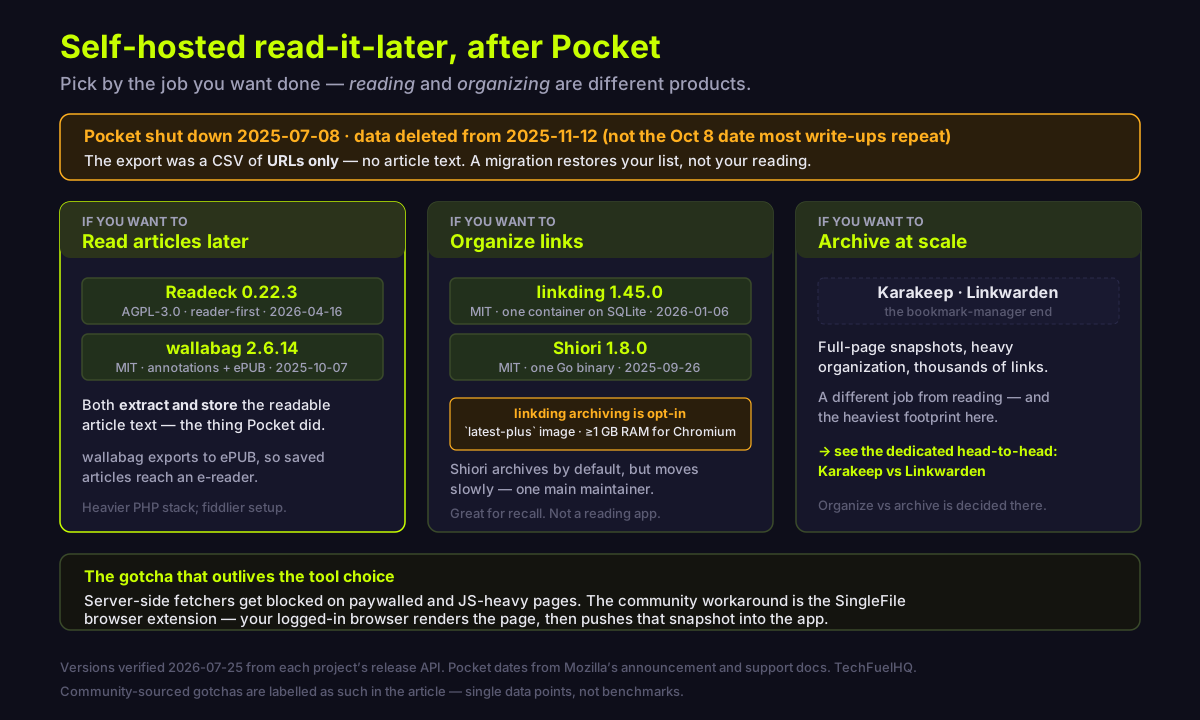
Pocket shut down on 2025-07-08 and deleted user data from 2025-11-12. Its export was a CSV of URLs only, not your saved article text. Self-hosted replacements that store readable content include Readeck and wallabag; linkding and Shiori save links with optional archiving. Pick by whether you want to read or to organize.
By LK Wood IV · Published 2026-07-25 · Updated 2026-08-22 · ~11 min read · St. Louis County, MO
TL;DR · Decide whether you want to read or to organize
- Pocket is gone — shut down 2025-07-08, data deleted from 2025-11-12 (not the October 8 date most write-ups repeat).
- The export was URLs only. Mozilla's CSV did not contain your article text, so no migration carries your saved reading across.
- Want to read? Readeck (0.23.1, AGPL-3.0) or wallabag (2.6.14, MIT) — both extract and store the readable article.
- Want to organize links? linkding (1.46.2, MIT — one container on SQLite) or Shiori (1.8.0, MIT, single Go binary).
- Want archive-everything at scale? That is the bookmark-manager end — see Karakeep vs Linkwarden.
Versions checked 2026-08-22 against each project's release API. Check the changelog before copying a compose file.
What actually happened to Pocket
Mozilla announced the phase-out on 2025-05-22, writing that it had “made the difficult decision to phase out two products: Pocket, our read-it-later and content discovery app, and Fakespot” (Mozilla). The service shut down on 2025-07-08 and dropped into export-only mode.
Here is the part almost every write-up gets wrong. The original announcement said data would be deleted after October 8, 2025, and that date is what got copied across the internet. It was superseded. Mozilla’s own support article states plainly: “As of November 12, 2025, user data export has been disabled, and all user data has been queued for permanent deletion” — the same date the Pocket API was switched off (Mozilla Support, via Internet Archive). If you are reading this in 2026 wondering whether your list is still recoverable: it is not.
Two details matter more than the dates, because they shape what a replacement can actually do for you:
The export was a CSV of links. Mozilla’s instructions told users to click “Export CSV file” at getpocket.com/export, and the support article is explicit that the file contains the URLs of saved items rather than the article text (Mozilla Support, via Internet Archive). Ten years of saved reading came back as a spreadsheet of addresses.
Every official escape route was another cloud. Mozilla published a list of “third-party services that we understand support the import of Pocket data” — GoodLinks, Futurwise, Instapaper, Matter, Raindrop.io and Readwise — while explicitly stating it had not vetted them (Mozilla Support, via Internet Archive). Every one is hosted. Not a single self-hosted option appeared — which is the whole reason this page exists.
Read-it-later or bookmark manager? Answer this first
Most “Pocket alternative” lists quietly mix two different products, and it is the single biggest source of disappointment when people migrate.
- A read-it-later app is built around consuming an article. It extracts the readable text, strips navigation and ads, and gives you a reader view — the thing Pocket actually was.
- A bookmark manager is built around organizing and preserving links, usually with a full-page snapshot so the page survives link rot. Excellent at recall; not necessarily a nice place to read.
Self-hosting threads keep re-litigating this, with people pointing out that a given “Pocket alternatives” roundup is mostly bookmark managers, and others arriving at the same conclusion after trying half a dozen tools. If your goal is “I want to read these six articles on the couch tonight,” a bookmark manager will technically store them and still leave you unsatisfied.
This page covers the reading end, plus the lightweight link-organizers people most often reach for as Pocket replacements — some of which describe themselves as bookmark managers, and are included here precisely because that overlap is where the confusion lives. What this page does not try to settle is heavyweight archival at scale: the two strongest options there get a dedicated head-to-head in Karakeep vs Linkwarden, which resolves the organize-versus-archive split within that category.
The tools, by the job they do
Readeck — the closest thing to “Pocket, self-hosted”
Readeck describes itself as an app that “lets you save the precious readable content of web pages you like and want to keep forever” (Readeck on Codeberg). That framing is the point: it is a reader first, an archive second.
Current stable is 0.23.1, released 2026-08-17, under AGPL-3.0, with the repository actively updated as of this writing (verified via the Codeberg API on 2026-08-22; 0.23.0 landed three days earlier). It is the tool that comes up most often in self-hosting threads as the recommendation over the heavier options, usually on resource-efficiency grounds — though that is community sentiment, not a benchmark.
wallabag — the veteran, and the one with real export
wallabag is the veteran option here. It is explicitly a content-extraction app — its README describes saving a web page and keeping only readable content, built on the Graby and php-readability extraction stack (wallabag README).
Current stable is 2.6.14, released 2025-10-07, under the MIT license, with commits on the default branch as recently as 2026-07-24. It is a PHP application requiring PHP 7.4+ and a PDO database — SQLite, MySQL/MariaDB, or PostgreSQL (requirements) — and the documented Docker quick-start runs on SQLite (installation).
Two things wallabag has that most of this field does not: in-article annotations and highlights (annotations docs), and per-article export to ePUB, PDF, XML, JSON and CSV, including exporting a whole category at once (download docs). If you want saved articles on an e-reader, that is the feature to look at. It also ships first-party Android and iOS apps plus the wallabagger browser extension.
Honest counterweight, from self-hosting threads rather than the docs: wallabag’s initial setup gets criticised for requiring an OAuth client ID and secret on top of a username and password, and one long-time user reported Android sync degrading past roughly fifteen thousand saved articles. Both are single data points, but the scale ceiling is the only concrete one anyone named in this space.
linkding — minimal, fast, and archiving is opt-in
linkding is positioned as a minimal, fast, Docker-first bookmark manager, and it is the tool the community reliably names when someone asks which is snappiest. Current stable is 1.46.2, released 2026-08-18, under the MIT license, on a steady cadence (1.46.0, 1.46.1 and 1.46.2 all shipped between 2026-08-09 and 2026-08-18; verified via the GitHub releases API on 2026-08-22). It is a Django app using SQLite by default, with PostgreSQL optional (no MySQL), and its image runs on ARM including Raspberry Pi.
The detail that surprises people: server-side archiving is not in the base image. HTML snapshots live in the latest-plus variant, which drives singlefile-cli against a headless Chromium, and whose documentation asks for at least 1 GB of RAM to run that Chromium (linkding archiving docs). linkding can also push pages to the Internet Archive instead of storing snapshots locally. So the “linkding is light” reputation applies to the base image — which is not the archiving one.
Shiori — one Go binary, slow and steady
Shiori is a bookmark manager distributed as a single Go binary, usable as a CLI or a web app, and explicitly modelled on Pocket (Shiori README). It does archive page content by default, parsing readable content and storing an offline copy. Current stable is 1.8.0, released 2025-09-26, MIT licensed, with SQLite by default and PostgreSQL/MySQL/MariaDB available.
The honest caveat is velocity: the project’s own FAQ describes it as maintained but slow-moving, with a single primary active maintainer (Shiori FAQ), and the browser extension is self-declared beta. The last stable release is the oldest of the four here — though the default branch had commits as recently as 2026-07-10, so this is a pace-and-bus-factor risk, not an abandoned project.
Footprint and capability, side by side
Versions verified 2026-08-22 from each project’s release API.
| Readeck 0.23.1 | wallabag 2.6.14 | linkding 1.46.2 | Shiori 1.8.0 | |
|---|---|---|---|---|
| Primary job | Read saved articles | Read + annotate + export | Organize links fast | Organize links, single binary |
| License | AGPL-3.0 | MIT | MIT | MIT |
| Latest release | 2026-08-17 | 2025-10-07 | 2026-08-18 | 2025-09-26 |
| Stores readable text | Yes | Yes (Graby extraction) | Base image: no; latest-plus: HTML snapshot | Yes, offline archive by default |
| Database | See Readeck docs | SQLite / MySQL / PostgreSQL | SQLite default, PostgreSQL optional | SQLite default, PostgreSQL / MySQL |
| Notable extra | Reader-first design | ePUB export, annotations | Internet Archive integration, ARM/Pi | CLI + web from one binary |
| Documented RAM figure | none published | none published | ≥1 GB for latest-plus (Chromium) | none published |
Nobody in this category except linkding publishes a RAM figure, and linkding’s is specifically for the archiving image. Treat any “uses only X MB” claim you read elsewhere as unverified unless it names a version and a workload.
What the Pocket export actually gives you
If you still have a CSV you exported before 2025-11-12, understand what it is before you plan a migration.
It is a list of URLs and metadata. Your new app will re-fetch each page itself — which means the result depends entirely on whether those pages still exist and still serve their content to a server-side fetcher. Pages that died, went behind a paywall, or now require JavaScript in the years since you saved them will not come back. One self-hoster hit exactly this warning while importing into Readeck; another reported a painless import into Karakeep. Both are single data points, and they are not contradictory — the import mechanics differ by tool, but the missing-article-text problem is Pocket’s, not the importer’s.
The lesson generalises past Pocket: a service that only stores your links is one shutdown away from being a list of 404s. That is the argument for running a tool that extracts and stores the article text — Readeck, wallabag, Shiori’s default archive, or linkding in its archiving image — rather than one that keeps only the URL.
Gotchas the project docs don’t mention
These come from self-hosting community threads rather than documentation. Each is one or a few data points — corroborate before betting on them.
- Paywalled and JS-heavy pages need the browser, not the server. The recurring workaround is the SingleFile browser extension: your logged-in browser renders the page, then pushes that snapshot into the app. Server-side crawlers get blocked precisely because they are not you. This one is not folklore — linkding documents the SingleFile-to-API upload path directly (linkding archiving docs).
- Cookie banners get archived too. They are part of the rendered page, and users report consent overlays dominating captured copies at scale.
- Reddit archiving was broken across tools as of June 2026 — one user reported Karakeep, Readeck with SingleFile, Linkwarden and linkding all failing to render post content, with a maintainer replying in the same thread (r/selfhosted). Timestamped deliberately: this is the kind of thing that gets fixed, so re-check before assuming.
- “Archived” and “readable offline in the app” are different claims. One Karakeep user found the offline copy existed server-side but was not viewable in the iOS app. Test the phone path specifically.
- Resume-reading position is a feature people repeatedly miss. Its absence is cited across separate threads as the reason users abandoned an otherwise good tool.
Which one should you run?
Choose Readeck if you want the closest thing to what Pocket was — a reader-first app whose job is making saved articles pleasant to read, with a current release and an active repo.
Choose wallabag if you want the mature option, annotations, and above all ePUB export to get saved articles onto an e-reader. Accept a heavier PHP stack and a fiddlier initial setup.
Choose linkding if speed and a tiny footprint matter more than reading experience, and you either do not need local archiving or are willing to run the latest-plus image with the RAM that Chromium wants.
Choose Shiori if you want one binary, no database server, and a CLI — with open eyes about a single-maintainer pace.
Choose neither, and read the bookmark-manager comparison instead, if what you actually want is durable full-page archival with heavy organization across thousands of links. That is a different job, and Karakeep vs Linkwarden resolves it.
Whichever you pick, it belongs on the same box as the rest of your stack — see self-hosted apps that replace SaaS for how this fits alongside the other dozen services worth running, and back it up: a reading archive you never backed up is a reading archive you will eventually lose, which is exactly what the 3-2-1 backup rule is for.
Related reading
- Karakeep vs Linkwarden — the bookmark-manager end of this category, organize vs archive
- Self-hosted apps that replace SaaS — where a read-later app ranks against the other candidates
- BookStack on Docker — for docs you write, rather than pages you save
- Paperless-ngx setup — the same archive-and-search idea, for scanned paper
- The 3-2-1 backup rule — because a self-hosted archive is only as good as its backups
Sources
- https://blog.mozilla.org/en/mozilla/building-whats-next/ — Mozilla’s phase-out announcement (2025-05-22)
- https://web.archive.org/web/20260502145211id_/https://support.mozilla.org/en-US/kb/future-of-pocket — Mozilla Support, shutdown and deletion dates (archived; the live host is behind a bot challenge)
- https://web.archive.org/web/20250802094606id_/https://support.mozilla.org/en-US/kb/future-of-pocket — earlier capture of the same page, carrying the third-party import list (archived)
- https://web.archive.org/web/20260420164430id_/https://support.mozilla.org/en-US/kb/exporting-your-pocket-list — Mozilla Support, export format (archived)
- https://codeberg.org/readeck/readeck — Readeck source, releases and license
- https://readeck.org/en/docs/ — Readeck documentation
- https://raw.githubusercontent.com/wallabag/wallabag/master/README.md — wallabag extraction stack
- https://doc.wallabag.org/admin/installation/requirements/ — wallabag requirements
- https://doc.wallabag.org/admin/installation/installation/ — wallabag Docker quick-start (SQLite)
- https://doc.wallabag.org/user/articles/annotations/ — wallabag annotations
- https://doc.wallabag.org/user/articles/download/ — wallabag export formats
- https://github.com/sissbruecker/linkding — linkding source, releases and license
- https://linkding.link/installation/ — linkding installation and image variants
- https://linkding.link/archiving/ — linkding archiving,
latest-plus, SingleFile and the 1 GB RAM figure - https://raw.githubusercontent.com/go-shiori/shiori/master/README.md — Shiori design, storage backends and license
- https://raw.githubusercontent.com/go-shiori/shiori/master/docs/faq.md — Shiori FAQ, maintenance pace
Community reports. The gotchas section and the tool-by-tool caveats draw on r/selfhosted threads read via a front-end mirror; the canonical thread URLs are below. Each is community sentiment — usually one or a few data points — not an authority, and is labelled as such in the body.
- https://www.reddit.com/r/selfhosted/comments/1ktgzpf/ — the Pocket-shutdown thread
- https://www.reddit.com/r/selfhosted/comments/1sc0vpd/ — “What bookmark manager are you currently using?”
- https://www.reddit.com/r/selfhosted/comments/1ea8w8o/ — “Current favourite read-it-later app — Readeck”
- https://www.reddit.com/r/selfhosted/comments/1u4a11c/ — Reddit archiving broken across tools (June 2026)
- https://www.reddit.com/r/selfhosted/comments/1pqspwj/ — “Still no true Omnivore read-it-later replacement?”
- https://www.reddit.com/r/selfhosted/comments/1gr87l0/ — “Read it later application”
- https://www.reddit.com/r/selfhosted/comments/1fu8l1s/ — self-hosted read-it-later recommendations
- https://www.reddit.com/r/selfhosted/comments/186rsrv/ — wallabag scale and sync reports
- https://www.reddit.com/r/selfhosted/comments/1q12fw3/ — Karakeep 2025 wrapped (maintainer post; treat as vendor claim)
- https://www.reddit.com/r/selfhosted/comments/1pi72bt/ — Linkwarden mobile launch (maintainer post; treat as vendor claim)
Frequently asked questions
What happened to Pocket, and when was the data deleted?
Which self-hosted read-it-later apps can import from Pocket?
What is the difference between a read-it-later app and a bookmark manager?
Which self-hosted read-it-later app is the lightest?
How do I save paywalled or JavaScript-heavy pages?
Do these apps remember where I left off in an article?
Evidence ledger
- Last updated
- Methodology
- See our methodology for research and review standards.
- Update log
- 2026-08-22 — Goal-5 segment 09 (2026-08-22): version lines re-checked against the release APIs. Readeck 0.22.3 (2026-04-16) -> 0.23.1 (2026-08-17; 0.23.0 on 2026-08-14) per the Codeberg releases API; linkding 1.45.0 (2026-01-06) -> 1.46.2 (2026-08-18; 1.46.0 on 2026-08-09, 1.46.1 on 2026-08-14) per the GitHub releases API; wallabag 2.6.14 (2025-10-07) and Shiori 1.8.0 (2025-09-26) unchanged. TL;DR, hero alt, both version-check lines, the tool sections, the side-by-side table and the hero SVG updated; byline re-stamped. wallabag requirements (PHP >= 7.4; SQLite, MySQL/MariaDB, PostgreSQL) and the linkding archiving page (‘Running Chromium requires significantly more memory, at least 1 GB of RAM’) re-confirmed live.
- Corrections
- Spotted an error or a stale number? Email hello@techfuelhq.com. Confirmed corrections are added to the update log above.