 TechFuel HQ
By LK Wood IV · 2026-06-19 · ~12 min read · St. Louis County, MO
Prices on this page were re-checked on 2026-09-13. I opened every listing in the price table that day and added up complete setups. Most of them run above the June 2026 figures this page first carried, during the 2026 RAM and SSD price crisis. Used listings sell out and retail prices move, so treat each figure as that day’s price.
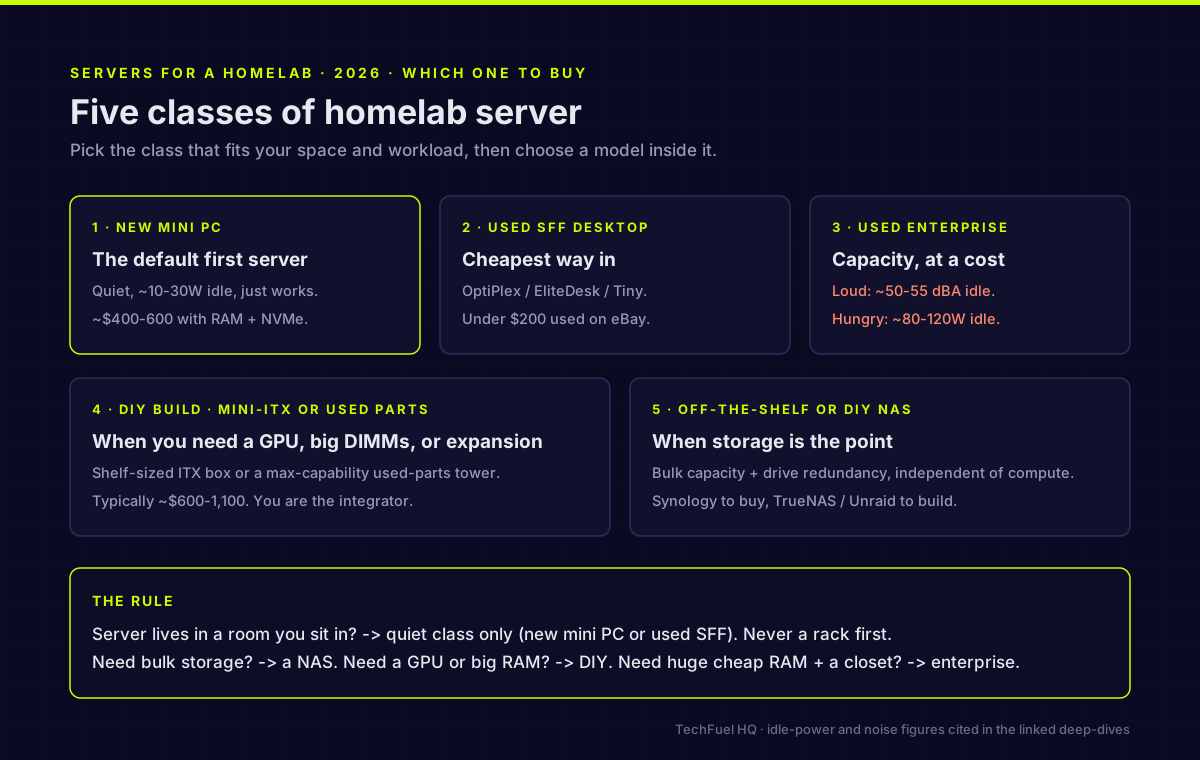
Search “homelab server” and you fall straight into a Reddit thread, a “what is a homelab” explainer, or one person’s build log. None of them answer the question you have. Out of all the things people call a homelab server, which one should you buy? This page is the routing map. It frames the five real classes of server, tells you in a paragraph who each one is for, gives you a decision rule you can apply in two minutes, and then points you down to the detailed guide for whichever class fits.
This page is a chooser. Specs live elsewhere. Where a class deserves a full breakdown, the deep-dive lives on its own page and is linked inline.
Start here: what kind of server do you need?
A “homelab server” is just a computer you run at home to host services and to learn on. The hardware can take five broadly different shapes, and the right one is decided almost entirely by three questions:
- Where does it live? A living room, office, or bedroom rules out anything loud. A basement, closet, or garage with a door opens up the noisy options.
- What does it run? A handful of containers and a couple of VMs needs very little. Many VMs, big storage, or local AI changes the answer.
- What do you care about — quiet and cheap-to-run, or capacity and expandability? You usually cannot max out both at once.
Hold those three answers in your head as you read the classes below. If you are not sure how much hardware your workload needs, the Proxmox hardware requirements guide translates “I want to run X” into real hardware numbers. Read that first if you are starting from zero.
The homelab purchases I regret page is worth reading alongside this one, and it starts with the used rack server.
The five classes of homelab server
1. New mini PC — the default first server for most people
A modern mini PC (an Intel N150 box, a Beelink, an ASUS NUC, or a Minisforum MS-01) is a full x86 computer the size of a paperback. It runs Proxmox, idles in the single-to-low-double-digit watts, and is effectively silent. You buy it, add RAM and an NVMe drive, and you are done. No parts list, no assembly.
Who it’s for: Anyone whose server lives in a living space, anyone who wants a clean “it just works” box, and anyone running a normal homelab of a dozen-or-so containers and a few VMs. The MS-01 in particular adds dual 10GbE for people who want real network virtualization. The main ceiling is RAM (typically 64–96 GB) and a single small chassis.
For specific models, idle-power figures, and which tier to buy, see Best Mini PC for a Homelab 2026.
2. Used small-form-factor (SFF) desktop — the cheapest legitimate way in
A used Dell OptiPlex Micro, HP EliteDesk Mini, or Lenovo ThinkCentre Tiny is the value entry point. These are ex-corporate machines with 8th-gen-or-newer Intel chips, built to run reliably on an office desk for years. On 2026-09-13 I found an HP EliteDesk 800 G6 Mini with 16 GB and a 256 GB SSD listed at $194 plus $14.55 shipping, and one with 16 GB and 512 GB of storage at $199.99 delivered. The Dell OptiPlex 7070 SFF in the price table below was $209 plus $15 shipping. Check each listing for power and returns. Both HP listings said no power adapter was included, and the $194 one takes no returns. The Dell listing names no power cord.
Who it’s for: Budget-first builders, anyone who wants to learn what Proxmox feels like before spending real money, and cluster-curious people who want three nodes for high-availability practice without a $1,500 bill. The trade-offs are older platforms, usually a single gigabit NIC, and a lower RAM ceiling (often 32 GB). That is fine for a single node and limiting once you cluster.
These used SFF picks are covered alongside the new mini PCs in the mini PC homelab guide (the value tier), since they compete in the same quiet, low-power category.
3. Used enterprise tower or rack server — capacity, at a cost
This is the romanticized option, a used Dell PowerEdge or HP ProLiant several generations old. The Dell T420 in the price table below came with two Xeons and 32 GB of ECC memory for $369.99, before drives and cords. The class is genuinely unbeatable on RAM-per-dollar, drive density, and out-of-band management (iDRAC / iLO lets you manage the box remotely as if you were standing at it). What the sticker price hides is the running reality: a rack server idles far louder and far hungrier than a mini PC, and that gap compounds every hour of every day it runs.
Who it’s for: People who genuinely need a high RAM ceiling cheaply (many simultaneous VMs, large databases, lab environments), 8+ drive bays in one chassis, or remote management, and who have a basement, closet, or dedicated room where noise does not matter. A tower server (HP ML-series, Dell T-series) is the quieter, more home-friendly subset of this class; a 1U/2U rack is the loudest.
Before you buy on the cheap-RAM pitch alone, read the head-to-head: Used Enterprise Server vs Mini PC for Homelab. It runs the noise and power math, the RAM ceiling and a three-year ownership total so you can see exactly when the enterprise box wins and when it does not.
4. DIY build — Mini-ITX or a used-parts server
If no off-the-shelf box fits, you build one. There are two flavors. A Mini-ITX build gives you a full desktop CPU, a real PCIe x16 slot for a GPU (AI inference, hardware transcode, a gaming VM), standard DIMMs, and more storage slots than a mini PC, all in a shelf-sized case. A used-parts build chases maximum capability per dollar by mixing second-hand enterprise or consumer components into a tower.
Who it’s for: Builders who want a discrete GPU, more than ~64 GB of RAM, or expansion cards, and who are comfortable picking parts and assembling. The cost is money (ITX motherboards and cases carry a premium) and effort (you are the integrator and the warranty). It is the next step up from a mini PC. It is rarely where to start.
The DIY route trades convenience for control; used enterprise vs mini PC weighs the used-gear half of that decision.
5. Off-the-shelf or DIY NAS — when storage is the point
Sometimes the “server” you want is really a storage appliance, a place to keep your files and backups with drive redundancy, running quietly and independently of whatever else you tinker with. That is a NAS. You can buy a turnkey unit (Synology, QNAP, UGREEN) for the least-fuss path, or build one running TrueNAS, Unraid, or OpenMediaVault for more capacity and control per dollar.
Who it’s for: Anyone whose primary need is bulk storage with redundancy rather than compute, anyone who wants their storage layer to stay up even while they break and rebuild their compute node, and households centralizing their photos and backups. Many mature homelabs run both, a quiet compute node plus a separate NAS.
For the build side of this class, including the 2026 hard-drive-shortage angle, see Best Budget NAS Build 2026.
What a complete setup cost on 2026-09-13
I priced one complete setup in each class on 2026-09-13 and opened every listing myself that day. Each setup includes the machine with its RAM and storage, either in the listing or added at a live price. Where a used listing leaves out power cords or drive screws, the table says so, and I did not price them. New parts had to show In Stock at B&H. Used machines had to come from an eBay seller at 99.9% positive feedback or better who takes 30-day returns. I did not hunt for the lowest listings.
| Class | What I priced | Price on 2026-09-13 | Source |
|---|---|---|---|
| New mini PC | Minisforum M1-Plus, Core i5-12600H, in the 16 GB RAM / 512 GB SSD configuration | $739.00 | B&H |
| Used SFF desktop | Dell OptiPlex 7070 SFF, Core i5-9500, 16 GB RAM, 256 GB NVMe SSD (the listing’s included items name no power cord) | $224.00 ($209.00 + $15.00 shipping) | eBay listing |
| Used enterprise tower | Dell PowerEdge T420 (refurbished), two Xeon E5-2450, 32 GB ECC DDR3, PERC H710, eight empty 2.5-inch trays, plus a Samsung 870 EVO 500 GB boot SSD (the listing excludes power cords and does not mention drive screws) | $619.98 ($369.99 + $249.99 SSD) | eBay listing, SSD at B&H |
| DIY Mini-ITX build | Eight parts and no graphics card, listed below | $1,690.73 | B&H |
| Off-the-shelf NAS | UGREEN DXP4800 Plus (8 GB DDR5, UGOS Pro installed) with two Seagate IronWolf 4 TB drives | $1,097.99 ($619.99 + 2 × $239.00) | NAS at B&H, drives at B&H |
The Minisforum MS-01 from section 1 was $1,221.94 at B&H in its 32 GB RAM / 1 TB SSD configuration.
Here is the ITX build, part by part, at B&H prices on 2026-09-13.
- AMD Ryzen 5 9600X, $220.00 (integrated Radeon graphics, no cooler in the box)
- ASUS ROG Strix B850-I Gaming WiFi, $328.99
- Corsair Vengeance DDR5-6000, 32 GB (2 × 16 GB), $533.99
- Samsung 990 EVO Plus 1 TB, $289.99
- Cooler Master MasterBox NR200, $89.79
- Corsair SF750 Platinum, $199.99
- Cooler Master Hyper 212 Spectrum V3, $19.99
- Corsair TM30 thermal paste, $7.99
I checked cooler height and power supply length against spec sheets and have not built this one. I did not check RAM clearance. The NR200 takes a cooler up to 155 mm tall, and the Hyper 212 Spectrum V3 is 152 mm. The case takes a power supply up to 130 mm long. The SF750 is 125 mm. ASUS lists Ryzen 9000 support for the B850-I, with two DDR5 slots that hold up to 128 GB.
Memory drives most of these totals. The 32 GB DDR5 kit cost $533.99, close to the $548.99 the CPU and motherboard cost together. The T420’s 500 GB boot SSD cost $249.99, two-thirds of what the server itself cost. Dell’s T420 manual lists SSDs alongside SAS and SATA drives for its 2.5-inch bays, and it has you screw each drive into its carrier. The listing does not mention screws. The used SFF desktop is still the cheap way in, and the M1-Plus costs more than three times as much. The T420 setup comes in about $119 under the M1-Plus. I would still skip it as a first server, for the reasons in the next section.
Why a used rack server is usually the wrong first homelab
The internet loves the cheap-rack-server flex, so it is worth being blunt about why it bites most newcomers.
Noise. A used Dell R720-class rack server at idle measures roughly 50–55 dBA at one meter, about the volume of a conversation happening next to you, constantly. Under load it climbs to 70–80 dBA. A mini PC at idle is effectively silent. Unless your server lives behind a closed door away from where you live, the rack server is unlivable, and “I’ll just put it in the closet” underestimates how far that whine carries.
Power. A rack server commonly idles at 80–120 W; a mini PC idles at 10–18 W. On a machine that runs 24/7, that gap is the difference between a few dollars a month and a noticeable line on your power bill, and it persists for the entire life of the server. The full region-by-region math, including what each class costs annually, is in 24/7 Homelab Idle Power Costs.
Space and heat. Rack gear is deep and heavy, and it dumps real heat into the room. It assumes rack rails and airflow that most homes do not have.
The community consensus that shows up over and over in r/homelab “if I started over” threads is consistent: begin with a quiet, low-power box (a mini PC or a used SFF desktop), learn the software, and only move to enterprise gear once you have hit a real wall (RAM, drive bays, or remote management) that the small box genuinely cannot clear. The cheap rack server makes a great second or specialized server. As a first one it usually disappoints.
The decision rule
Walk it top to bottom and stop at the first match:
- If your server lives in a room you sit in → quiet class only. Start with a new mini PC (cleanest) or a used SFF desktop (cheapest). Do not buy a rack server.
- If your main goal is bulk storage with redundancy → a NAS (buy off-the-shelf for least fuss, build it for capacity per dollar).
- If you want the cheapest possible way to learn Proxmox → a used SFF desktop (the one I priced in September 2026 was $224 delivered with RAM and an SSD, power cord not listed), and add a second one later to learn clustering.
- If you need a GPU, big DIMMs, or expansion cards and you can live in a room with the box, or you want it shelf-sized → a DIY Mini-ITX build.
- If you genuinely need 128 GB+ RAM cheap, 8+ drive bays, or iDRAC/iLO, AND you have a basement/closet/dedicated room → a used enterprise server (a tower if you want it quieter, a rack if noise truly does not matter).
- If you are not sure how much hardware you need → settle that first with the Proxmox hardware requirements guide, then come back and re-run this rule.
A large share of homelabs that have been running for a year or two converge on the same shape: one quiet, low-power compute node (mini PC or SFF) doing the day-to-day work, plus a separate NAS for storage, with enterprise gear added only for a specific job it is uniquely good at. If you build toward that from the start, you rarely buy the wrong thing twice.
Sources
- Search volume, keyword difficulty, and search intent for “homelab server” / “servers for homelab” / “home lab server”: DataForSEO Labs and Google Ads keyword data, accessed 2026-06-19 (head term ~1,600/mo, KD 12, navigational + commercial intent).
- Live SERP and People Also Ask for “homelab server”: DataForSEO Google organic results, accessed 2026-06-19 (Reddit r/homelab, joekarlsson.com “How to get started building a Homelab server in 2026”, stormagic.com, dev.to build logs).
- Decision framework for used rack server vs mini PC, with manufacturer-sourced RAM, storage and management figures and the wall-power and noise questions to ask a seller: Used Enterprise Server vs Mini PC for Homelab and 24/7 Homelab Idle Power Costs, with mini PC idle figures measured at the wall in Best Mini PC for a Homelab 2026.
- “Start with a mini PC or used SFF, not a loud rack” newcomer consensus: r/homelab “if you could start your homelab over” discussion threads (top of the live SERP for the head term), accessed 2026-06-19.
- Prices, stock and seller terms for the setup table: every B&H product page and eBay listing linked in that table and just below it, plus the two HP listings linked in the used SFF section, opened 2026-09-13. B&H’s DXP4800 Plus specification tab supplied its memory and installed operating system. The eBay seller descriptions supplied what each used machine includes (the T420 listing excludes drives and power cords; the OptiPlex listing’s included items name no power cord). The two HP EliteDesk 800 G6 Mini listings supplied the no-adapter examples, and the $194 listing states that the seller does not accept returns.
- ITX fit checks: ASUS ROG Strix B850-I Gaming WiFi specifications for Ryzen 9000 support and two DDR5 slots up to 128 GB, and B&H specification tabs for the NR200 (155 mm cooler height, 130 mm power supply length), Hyper 212 Spectrum V3 (152 mm), SF750 (125 mm) and Ryzen 5 9600X (integrated Radeon graphics, no cooler included), opened 2026-09-13.
- T420 drive support: Dell PowerEdge T420 Systems Owner’s Manual, the hot-swappable hard drive section (up to sixteen 2.5-inch SAS, SATA or SSD drives) and the section on installing a drive into a carrier with screws, opened 2026-09-13. I found no Dell document naming the power cord connector for the OptiPlex 7070 SFF or the T420, so the table prices no cords.
Frequently asked questions
Which server is best for a home lab?
What is a homelab server for?
How much RAM do I need for a homelab?
Do I need a NAS for a homelab?
Is a used enterprise server worth it for a homelab?
How much does it cost to set up a homelab?
Sources and corrections
- Last updated
- Methodology
- See our methodology for research and review standards.
- Update log
- 2026-09-13 — Prices re-checked live: one complete setup per class priced on 2026-09-13 under a written selection rule, with every B&H page and eBay listing opened that day. Corrected the figures those prices contradict: the mini PC ($400 to $600) and DIY ($600 to $1,100) bands in the cost FAQ and the header image, and ‘well under $200’ for a used SFF desktop with RAM and an SSD. The FAQ’s $150 to $250 SFF band and the decision rule’s SFF price now carry the dated figure instead. The FAQ’s running-cost ratio now comes from this page’s own idle figures. Dashes, not-X constructions and triads reduced. Noise and idle-power figures were not re-checked in this update.
- Corrections
- Spotted an error or a stale number? Email contact@techfuelhq.com. Confirmed corrections are added to the update log above.